Rooted in Love: Rooted in Troncones
Santu Beauty blooms into a global brand
It’s like something out of a Troncones fairy tale. Two people come together and find they have a shared interest. In fact, it’s more than one. It’s a whole set of ideas about self-care, daily rituals and life-appreciation that neither of them expected would be anything other than something they mulled over quietly on their own. The notion that their passions could be “more” took on new meaning when they decided to launch a brand called Santu.
%2017.27.38.avif)
.avif)





.avif)
%20(Spanish)-2.avif)

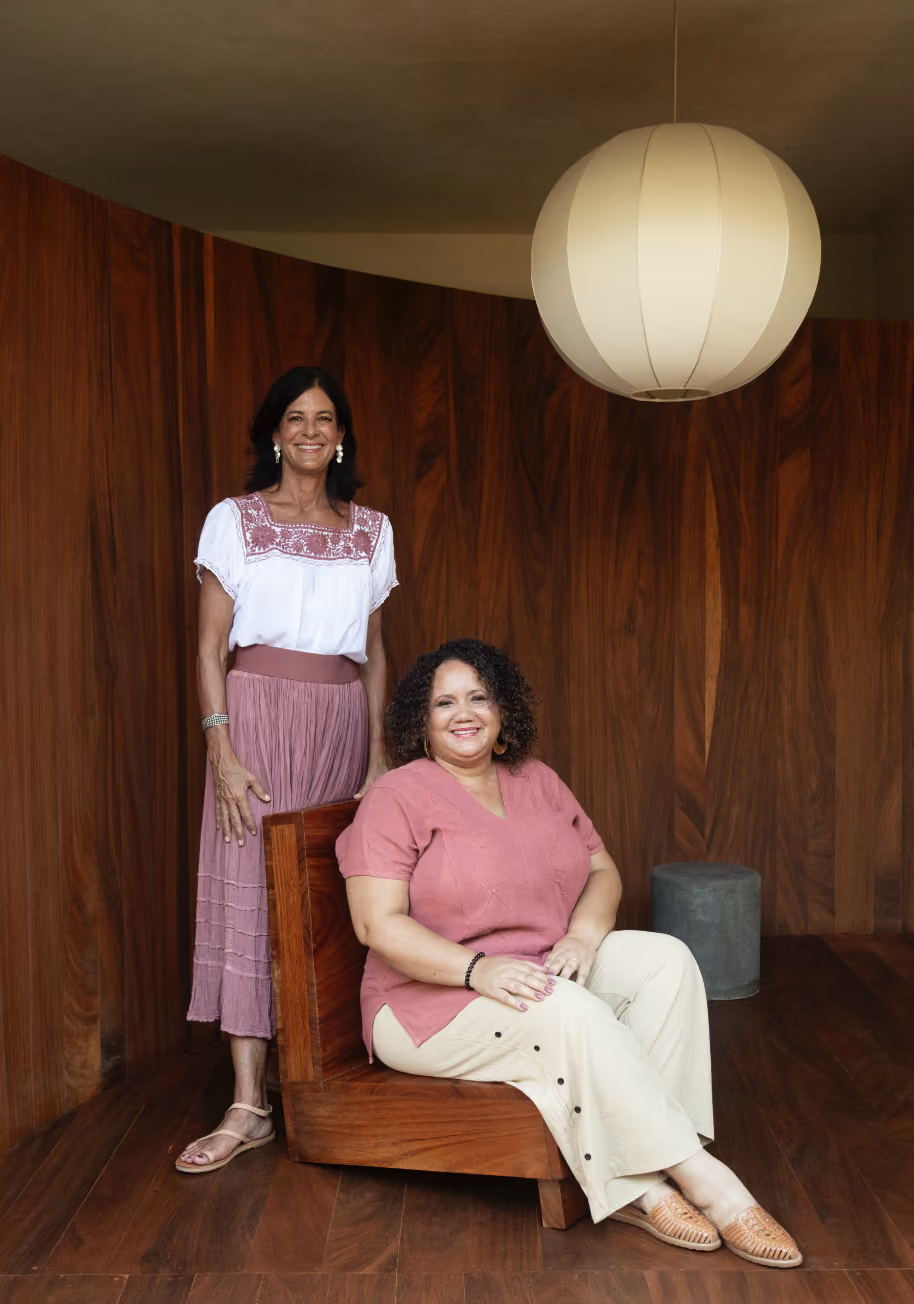
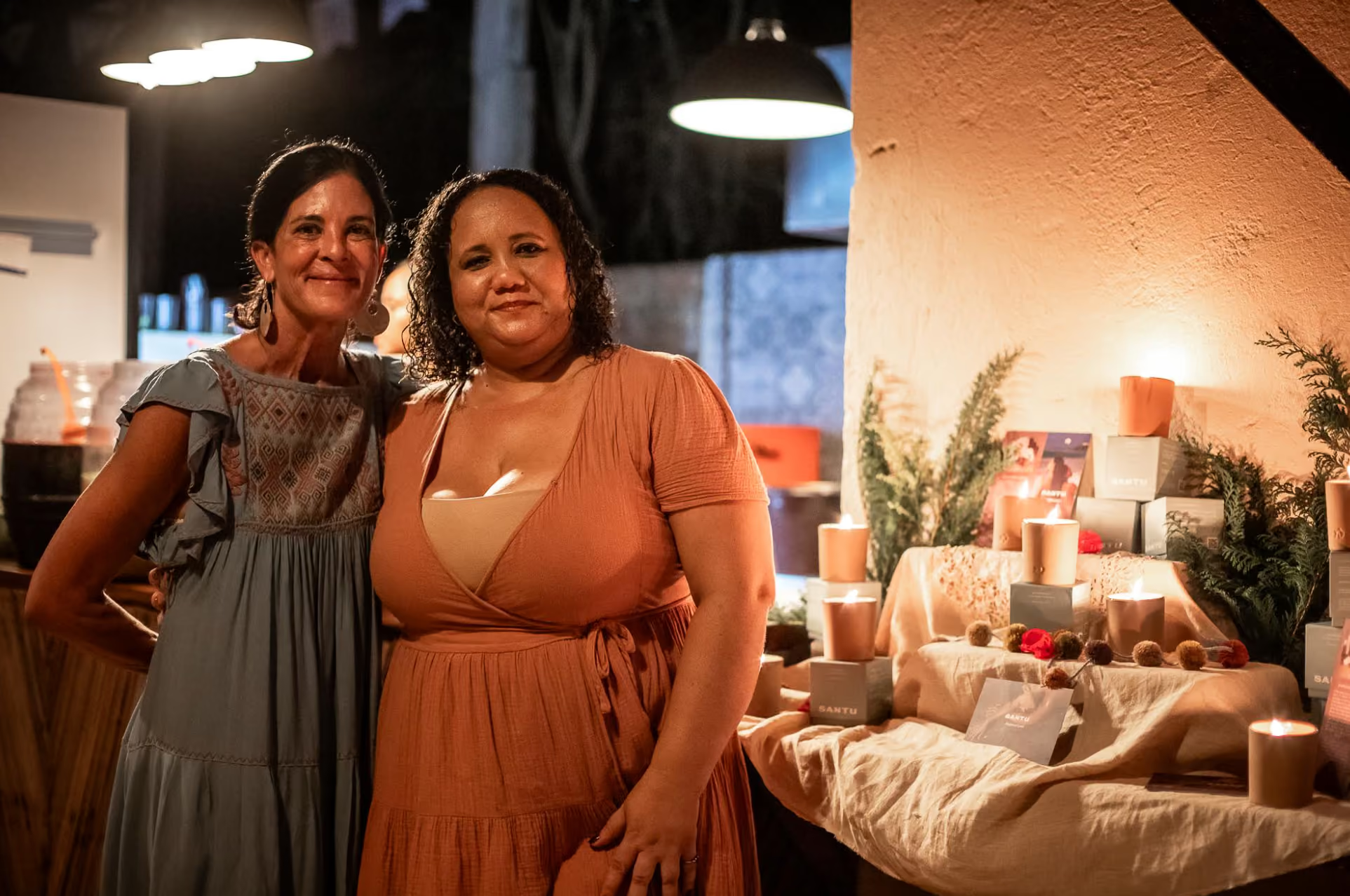
I never know what will happen when I sit down with someone. I do my homework, I come with questions and I do my best to find a setting that will keep us engaged. How the interview will go, what I’ll learn, how I’ll share what’s said and which format it might take on the page are always the furthest thing from my mind. When I sat down with Alicia Nogales and Angelique Van Wyk last week in an apartment above Manzanillo Bay, I wanted to hear about the story behind how they came to start Santu Beauty. They took me for a wild ride, of chance occurrences, self-realization and refreshing honesty. When I sat down to make sense of our hour-and-a-half together, I decided to break apart our Q&A, our dense blocks of conversation, into a shorter, more accessible story, to convey the connection between Alicia, Angelique and Troncones, to find a way to express what makes Santu special to them and to their growing following.
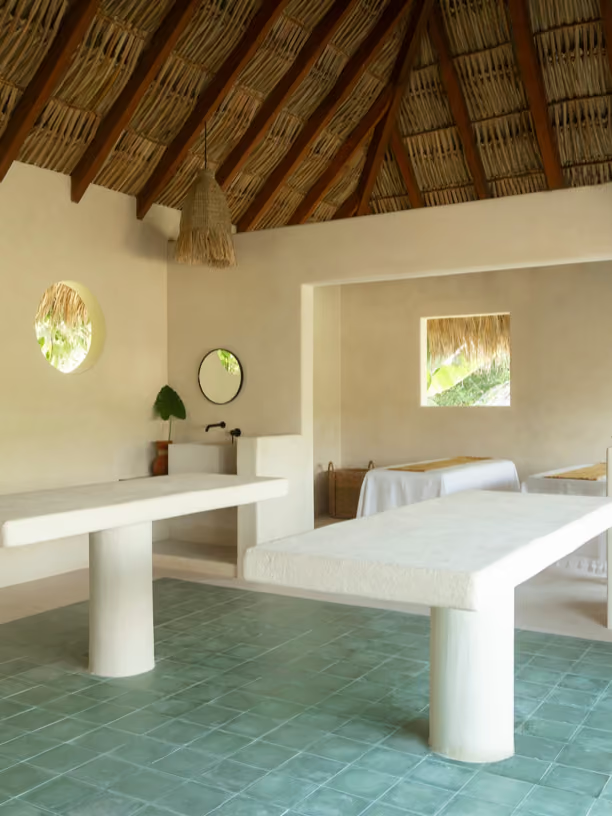
On the hillside above Troncones, there’s a new spa, a sanctuary that smells like copal, cacao and sea salt. Inside, smooth polished-cement beds are prepped and waiting. You lay down dry. A therapist covers you in a scrub. You can smell and feel the butters, the shea, the cacao and the mamey, the salt that you later learn is hand-harvested from the Guerrero coast. You start to drift and while the scrub sinks in, your hair is shampooed, your face is masked, and you’re rinsed clean without ever leaving the bed.
Five steps away, a massage table waits. By the time you go to leave, all the world seems tranquil, the din of dust, heat and what’s next that takes up a lot of each day seems far, far away. This is Angelique’s. From here, a beauty brand called Santu has been quietly widening its reach into the world—rooted in Troncones—rooted in the two women behind the brand.
ALICIA: THE BATHTUB THINKER
Alicia grew up moving between different worlds. She was born in 1969, while her Mexican-American father was at Stanford Law School. His family came from the migrant camps of Calexico and Mexicali, following the planting and picking seasons up and down the state of California. Alicia describes her mother as a “white gringa” with a masters’ degree in Latin American history. “I’m bicultural but not bilingual,” she explains, “I have a very Mexican father and Mexican-American family, but I didn’t grow up with the language because it was the time of assimilation. The rule was, ‘Don’t speak Spanish at home.’ So, all the Spanish I ever learned was in school.”
After growing up in Washington, D.C., going to college and creating a life in California, eventually Alicia settled in San Francisco, and now lives near the Presidio with her husband, Greg. Describing her environment there, Alicia says, “I live right off the park where I can walk through trees and connect with nature,” adding, “I need nature. I need that connection. I’m not a jewelry girl or a makeup girl. But I’m a water person. I do my best thinking in the bathtub.” Alicia says she takes baths five days a week, and every bath and shower product she can get her hands on ends up on the edge of the tub. She jokes that some people do business strategy work on whiteboards—she does it up to her neck in hot water.
Alicia came to Troncones for the first time twenty years ago, frequently staying on Manzanillo Bay, where she now lives. At first, she could only visit during her kids’ school vacations. Slowly, the stays got longer. Eventually the kids went to college, and she and Greg started spending more time here. On each trip and on each stay, Alicia sought out massage therapists, in fact, so frequently that a few neighbors mentioned something to her about always getting a massage. “I would say I was a massage slut,” she laughs. “I don’t care if you quote me. It’s true.” And Angelique, the woman who kept showing up with a portable table, body scrubs and magic hands seemed to materialize every time Alicia’s plane touched down.
ANGELIQUE: FROM CONVENT DISCO TO CRUISE SHIP SPA
Angelique was born a world away, in Springbok, in the Northern Cape province of South Africa, about six hours due north of Cape Town and two hours south of the border of Namibia. “In that area we had a lot of Germans coming through to Namibia, a lot of English and Dutch, and the Nama people,” says Angelique describing the people of the region. “I’m mixed race—not black, not white. I have cousins with white skin, green eyes, blonde hair, but we’re all the same culture.” She went to high school in a convent with nuns, surrounded by girls who only went home once a month. They made their own fun.
“By Friday everybody had to have their nails painted and their hair done. That was kind of my job,” Angelique remembers. “We didn’t have straightening irons. We used a normal iron.” She describes it—one girl sitting in a chair, her hair brushed out onto brown book-wrapping paper on the table, another girl pressing it with a hot clothing iron. The results were shiny and pin-straight hair, ready for the convent disco on Saturday night. “I liked the theater of it all. I was convinced I’d be an actress,” Angelique added. “I was always the lead in the school plays. I was even Jesus on the cross once. When I came down, my grandmother was crying. She said, ‘You just died on the cross.’”
Another thread ran through Angelique’s life—caretaking. Her grandmother was a nurse, while other women in her family were midwives and traditional healers. Angelique was always massaging someone’s feet, smoothing someone’s hair, organizing beauty rituals in the dorm. After high school, she asked her mother for one year to figure things out. She explained, “I said, ‘I don’t want to waste your money. Let me work and make up my mind.’”
Angelique moved to Cape Town, got a job in a Kodak photo shop, and after a year finally knew—she want to become a beauty and massage therapist. In South Africa, that isn’t a short course. It meant a full-time, two-year program in one of the best schools in the country, complete with courses in science, chemistry, dermatology, cosmetic science, nutrition, plus every treatment imaginable—massage, facials, body treatments, manicures, pedicures, waxing, spa operations. “In my first year, I had 32 subjects,” she recalled. “It was literally nine-to-five, plus Saturdays in the training spa, plus 200 hours of outside practice. It was its own career.”
At the end of the second year, examiners flew in from Europe to give the international board exams. Passing would allow you to work abroad. Angelique passed. She also passed a terrifying group interview for cruise ship spa work, standing on a stage in front of 60 classmates, answering a question about how to find your way out of a London airport. “They weren’t looking for the right answer,” she realized later. “They just wanted to see if you could stand there and be confident. I had one thing in my mind: ‘I need to get on that cruise ship.’”
And she did. In 2008, she was studying in London, then flew to Los Angeles to join a ship in dry dock, training for a life at sea. Her goals were simple—see Hawaii, live in the tropics, save enough to buy an apartment in Cape Town. Then she fell in love with a Mexican waiter from Tecpan de Galeana, a small town on the Costa Grande between Zihuatanejo and Acapulco. “I saw him, and I was in trouble,” she laughs.
In time, Angelique also fell in love with Mexico itself—aided by the ever-present scent of the ocean when she stepped off the gangway—in places like Puerto Vallarta, Acapulco and Zihuatanejo. On Facebook that year, she wrote, almost as a foreshadowing: “I’m in love with Mexico. I might just stay here.” Five years later, Facebook reminded her of that memory, which turned out to be written in the same month and on the same day as her wedding. By then, Angelique and her handsome waiter had a baby and had moved to Mexico so they could be together on land. “Be careful what you wish for,” she says. “It might come true in ways you don’t expect.”
A SPA OUT OF THE TRUNK OF A CAR
Angelique and her husband arrived in Ixtapa in 2010. They worked in a five-star resort for years—she in the spa, he in hospitality—until she felt the pull to do her own thing. “I opened a small place in Ixtapa in 2016,” she recalls. “People loved the treatments. But I’d get, ‘Can you do it for 200 pesos?’ I knew I needed something different.” A friend who had worked at the resort as a chef told her, “You have to see Troncones. There’s nothing else like it.”
Angelique and her husband drove out to see their friend and found her working at La Mexicana. They explored Troncones on their own, but didn’t know anyone or where to go. They saw enough to come back a few days later. Their friend, now off-work, introduced her to Natalie at Los Raqueros and to Belém at The Inn at Manzanillo Bay. Wanting to prove herself, Angelique offered Natalie a free massage, and said, “If you like it, you can recommend me.” That was in May of 2016.
Word spread fast. Angelique set up a table at La Mexicana’s market. Present Moment’s staff became her regulars. After the market, she’d drive up and down the beach road, going from house to house, offering massages, facials, waxing, pedicures—all out of the car. “I made my own scrubs and lotions with a small lab in Mexico City,” Angelique said. “I had my professional tubs and retail tubs. The car was my spa.” By November—just six months into this experiment—Angelique was so busy she rented a space in the village and hired three therapists. Her Ixtapa location couldn’t compete with the demand. Troncones had chosen her.
Her first spa in Troncones was a narrow little place near Present Moment’s bodega, sharing rent and walls with Carla, the local vet. Later, when a house near the beach became available, Angelique remembers summoning her courage, calling the owner and asking, “What do you think about me turning your house into a spa? She said, ‘I would love that.’ She gave me the keys and told me, ‘Clean it, do what you need to do. Start paying rent when you’re ready to open.’” That trust and generosity have evolved into Angelique’s.
THE MASSAGE ADDICT AND THE SCRUB MAKER
At some point in the late 20-teens, Angelique met Alicia. “I think I was probably her biggest client,” Alicia laughs. “I would email her before we came down, with all the massages for the family and a list like, ‘Can you get me five of these tubs? Ten of those?’” Angelique’s scrubs—thick, fragrant blends of salt, oils and butters—became an obsession. “I would take home professional sizes,” Alicia explains. “I couldn’t get enough of them.”
For seven years, this was their rhythm—Alicia and Greg arrive in Troncones, scrubs and salts appear, massage tables go up in the house, and the neighbors whisper about how often Alicia’s on the table. Then, one day a few years ago, Alicia, Angelique and Greg were sitting together, talking—again—about scrubs, massages and all the little rituals that made them feel human. The idea came up—why don’t we make this a business?
At first, the idea seemed almost too simple—take what Angelique already had, put a name on it and go. They had no idea, they admit now, what they were getting into. Alicia remembers it was Greg who insisted on creating a destination, a spa, a place that was its own other world, a place for sampling the product, adding, “We spent two years incubating before we actually launched with product.”
REVERSE ENGINEERING A RITUAL
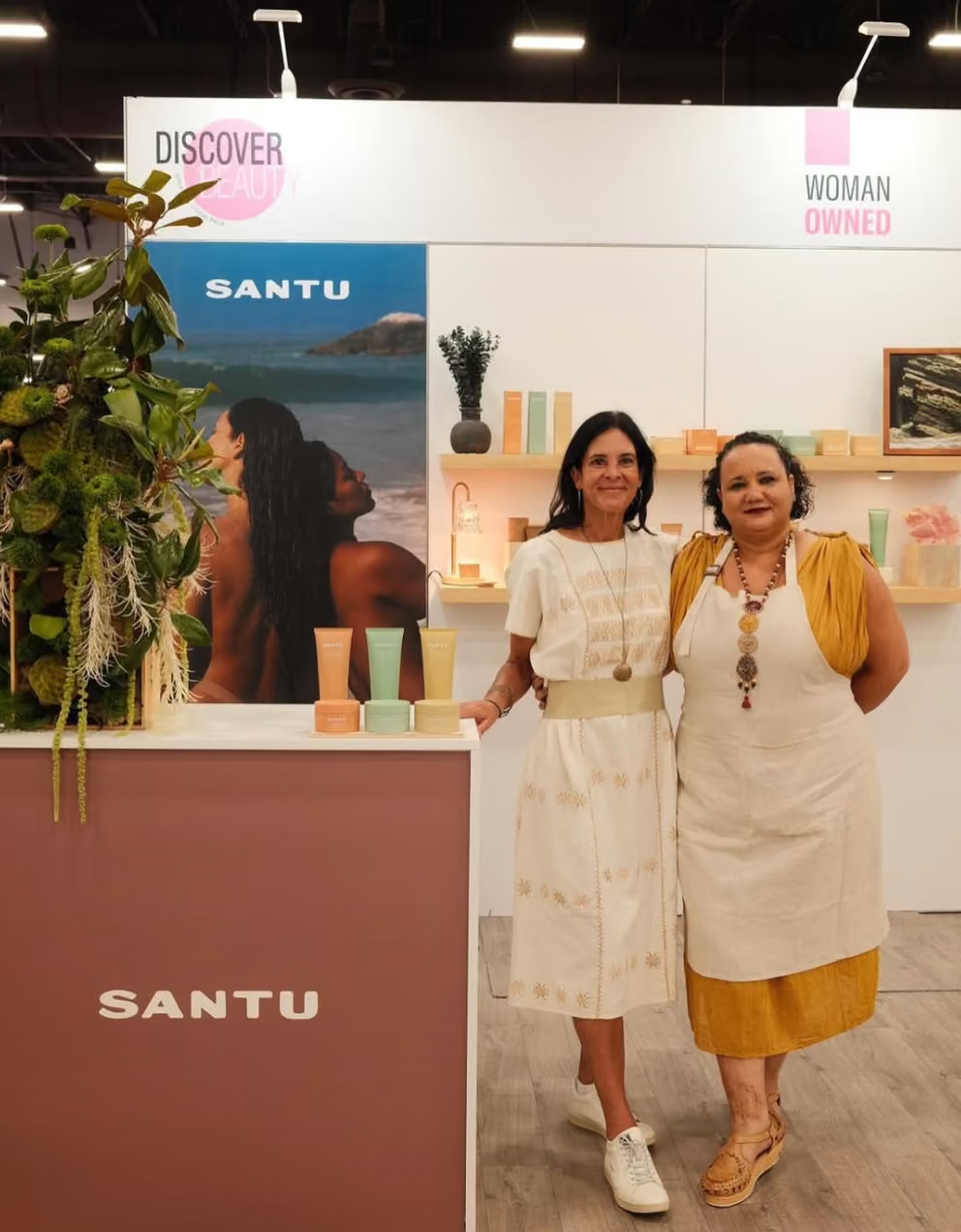
From that casual conversation and those two years of planning came Santu, a body-care line that is now produced in Mexico City and sold in both Mexico and the United States. The name Santu is short for Santuario—sanctuary, in Spanish. “Each of our bodies is a sanctuary,” explains Angelique. “We need each of us to take care of our body, of what we have, so that we can really be there for others. As Santu, we encourage everybody to do that little bit of self-love to really be there for ourselves and for others. Like when you’re on a plane and they say, put on your mask first. That’s what Santu means to me.”
Alicia added her own layer, saying, “You can’t love yourself enough. It’s impossible. Love doesn’t ever run out. It’s not like a commodity, or like money. The more you love yourself, the more you can do for your family, your community, your country. We want people to treat themselves the way a mother would want her child to treat themselves. It’s an integration of the physical, the emotional and the spiritual self, a reminder we are something sacred.” The tagline they eventually landed on—Rooted in Love—comes straight out of that line of thinking, that way of being.
Behind the scenes, they did something very un-breezy and un-beachy—they got serious. They hired a CEO, Sherry Wan, who works from the San Francisco Bay area. They spent two years testing formulas, finding the right manufacturer in Mexico City, figuring out how to move products across borders in a world of shifting tariffs and paperwork. “We reverse-engineered the scrubs,” said Alicia. “Angelique knows skin. I love products and ritual. Chemists in Mexico know how to make world-class formulas—they already make stuff for American and European brands. We said, ‘Let’s do that, but be proudly Mexican.’”
They insisted on a few non-negotiables, part of their ethos, their creed—that everything from the Santu lab work to the Santu product boxes to the Santu photo shoots be done in Mexico, made in Mexico—that their ingredients be rooted in Mexican ritual, especially copal, the tree resin burned for centuries in ceremony and now prized for its anti-inflammatory and antiseptic properties on skin—that the salt in Santu products used would be hand-harvested without plastic tarps [they found that process available on the Guerrero coast, by one of the last matriarchs still working the old way]—that all packaging would be recycled and recyclable using 50% post-consumer plastic in bottles and recycled paper in boxes—that Santu could qualify for Leaping Bunny certification, the strict cruelty-free standard used by Sephora and other major retailers—and a commitment to give back at least 1% of their equity to public-service projects, through the global Pledge 1% movement.
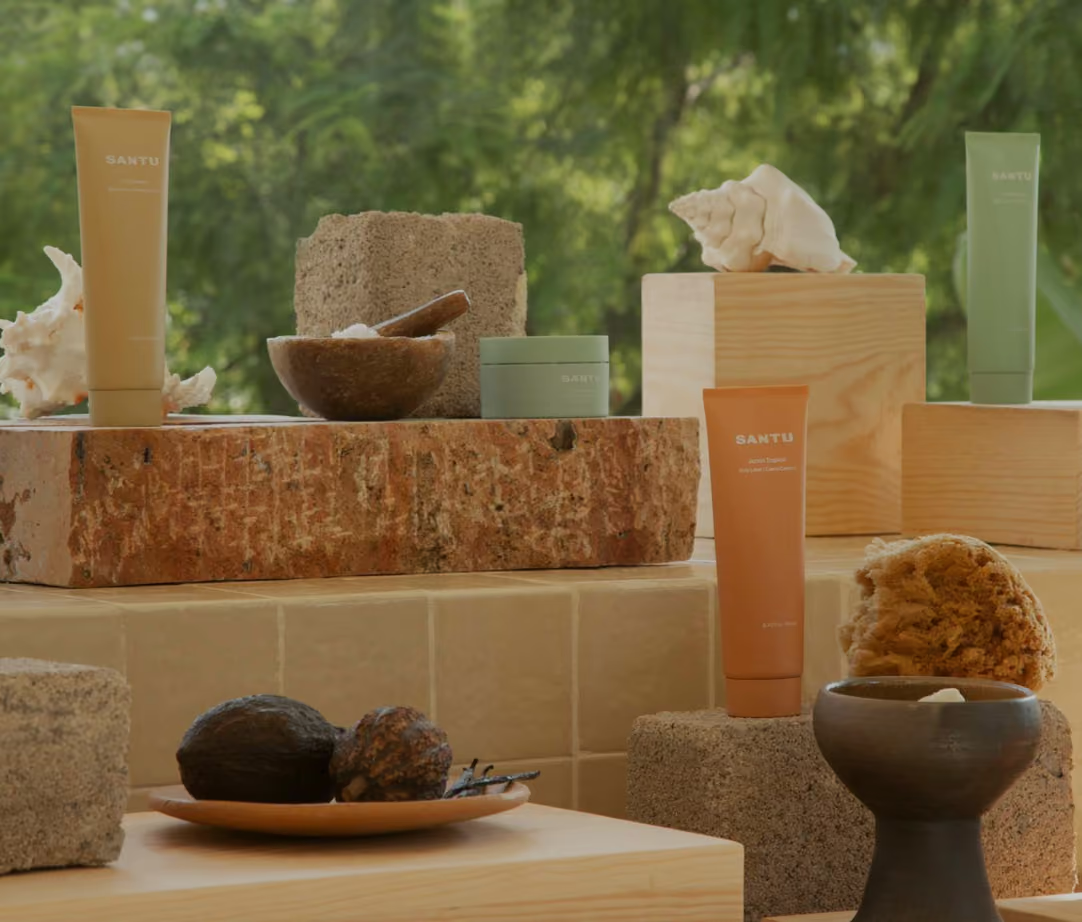
“We didn’t want to launch anything that couldn’t go straight into a Sephora or a serious retailer from day one,” Alicia says. “Even if we’re not there yet, we had to build it that way. We launched just 11 months ago. Already, here in Troncones, Santu is in the boutique at the spa, at The Inn at Manzanillo and at Casa Croma. We’re also in the Ritz-Carlton and St. Regis in Mexico City.” In the U.S., Santu is selling direct-to-consumer online. In Mexico, they’re focused on hospitality and retail partners—and preparing to enter a national department store chain this spring. “I’m visualizing finding Santu around the world,” added Alicia, “in Paris, London, South Africa. All of it.”
RITUALS, ROOTS & THE TRONCONES VORTEX
For all its spreadsheets and shipping paperwork, the core of Santu still comes back to something very simple—ritual. Alicia has a daily practice of intention—of dedication, gratitude and vision—a quiet three-part check-in she returns to throughout the day and again at night. She’s been practicing yoga for 29 years, that union of breath and movement helping her sustain her calm. While in Troncones, Alicia makes time to walk along the ocean at sunrise, watching the light and colors brighten as they move along the curve of the beach, the water and the mountains.
Angelique has her own practices. She takes her spa staff to Temazcal Tepeyollot in Troncones, to be guided by Fanny and Oscar, so they can release what they carry from holding space for other people. She also calls her parents every morning—they’re eight hours ahead in South Africa—and feels strangely “off” if her day starts without them. “They are my coffee and milk in the morning,” Angelique says. “They were the ones who believed in me when a teacher said I’d never finish high school. I finished with honors. I passed my international exam. I worked on ships. I built this business. And when the land for the spa came up, they were the ones who said, ‘Buy it.’”
Santu’s rituals may seem small and insignificant—a scrub in the shower, lotion on your hands between emails, salt and copal in the steam of a bath, a coconut or lime candle brightening your room. But they’re daily, they’re personal. They don’t and won’t promise any miracles—to erase wrinkles or subtract 15 years. “We invite self-acceptance,” Angelique says. “We encourage you to use good ingredients, feel good, smell good—to do it with intention.”

Troncones is not an incidental player in the Santu story. “I call this place a vortex,” Alicia explains. “I’ve never met anyone who doesn’t feel good here. There’s something about the air coming off this water. It’s some of the freshest air there is. And there’s a meaningful history here, too. Zihuatanejo used to have a sign reading, ‘La Tierra de las Mujeres’, the land of the women. We know the pyramids on the other side of the airport were run by women. There’s a feminine and masculine energy here that’s really palpable. There’s a lot of magic going on—in the cave with its Olmec hieroglyphics, at the thermal baths. You can feel it.”
Angelique expects Troncones will continue to change slowly, but in a good way. “We still feel Mexico here,” she explains. “Yes, it’s growing. But the mountain stops it from becoming a city, and the people are keeping the magic. We need tourists for the economy, but as long as we who live here model the values we want—respect, care, authenticity—Troncones will keep its soul.”
In a place where people greet you with, “What do you need? What can I get you?”, where nobody cares what you do for a living, and no one asks how important you are somewhere else, maybe that’s all the intention that’s needed for even the smallest rituals to have their effect, like waving at your neighbors as you drive by or taking time to find your own moment of quiet, your own sanctuary, each day. Like Alicia and Angelique suggest—to be rooted in love.