J. Santos Jaime Sánchez: More Lessons
Part Two
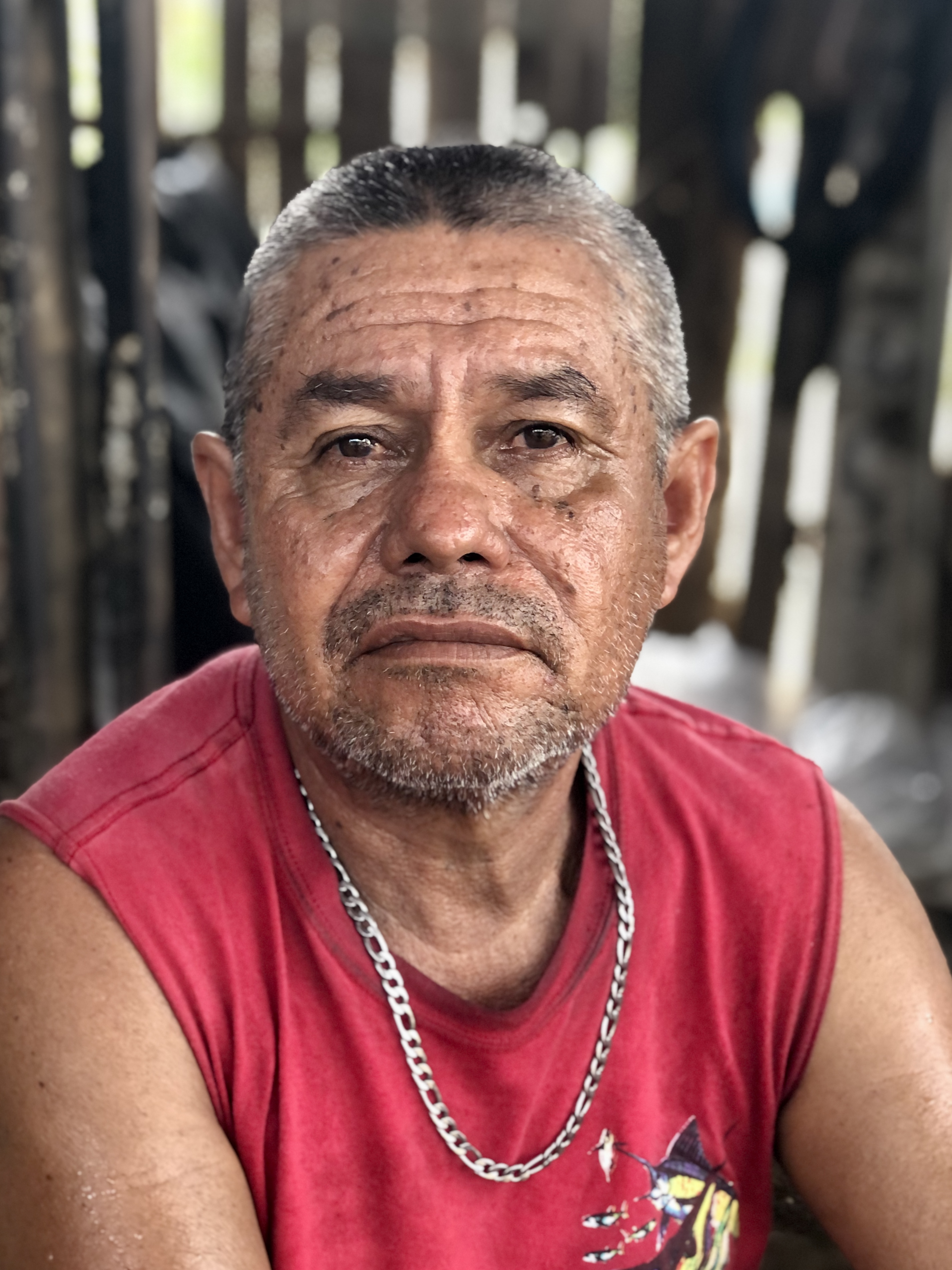
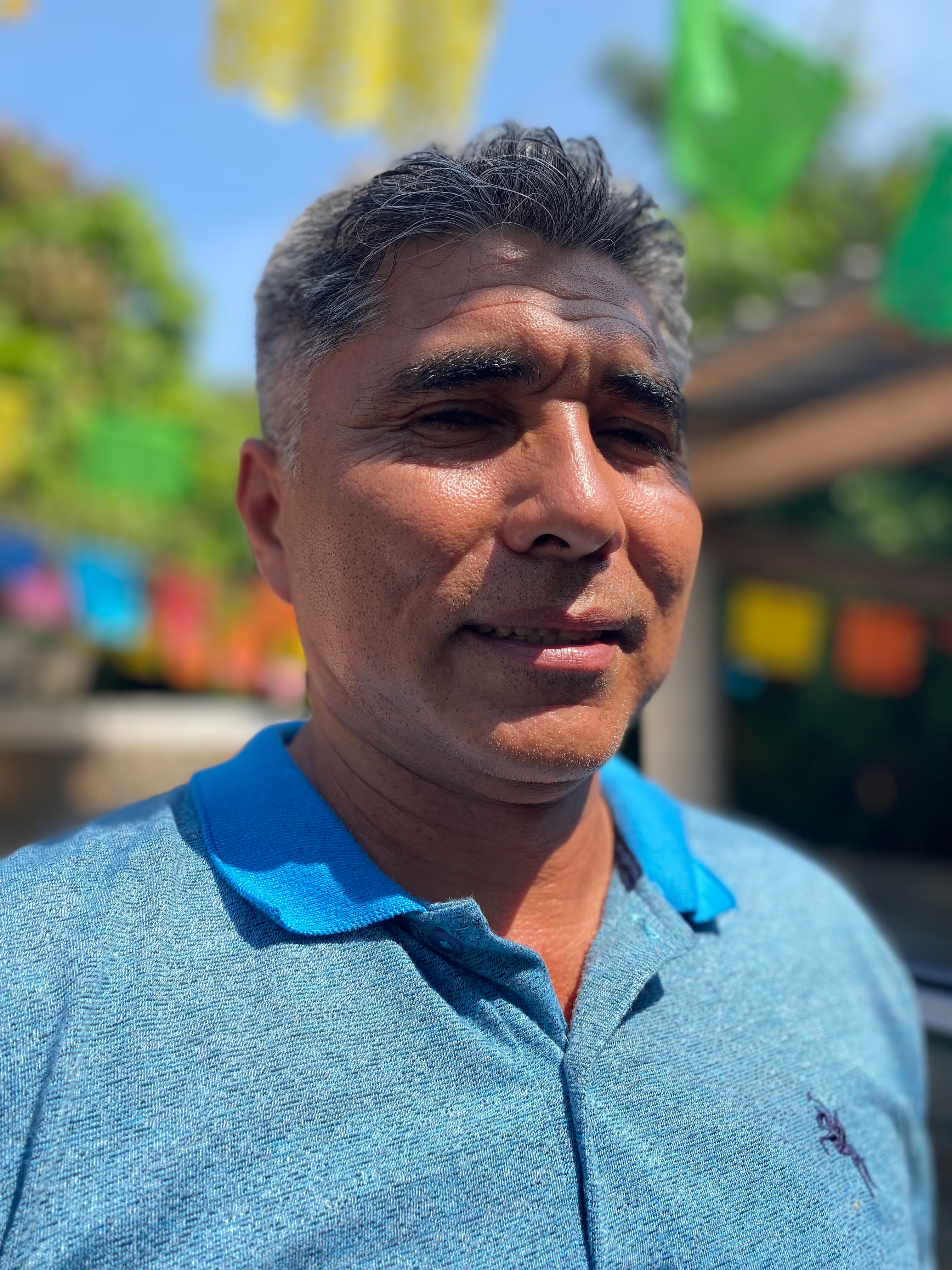
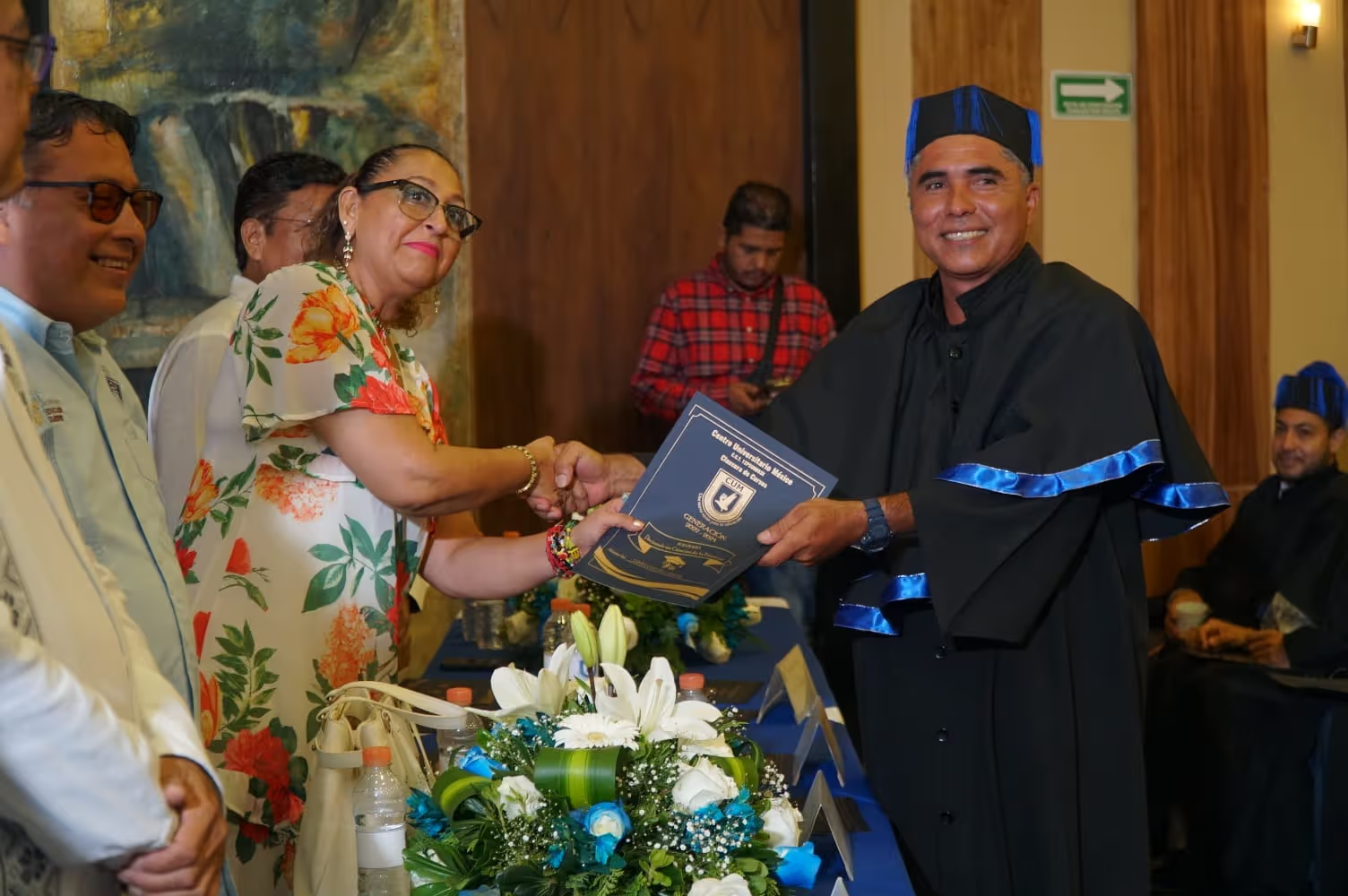
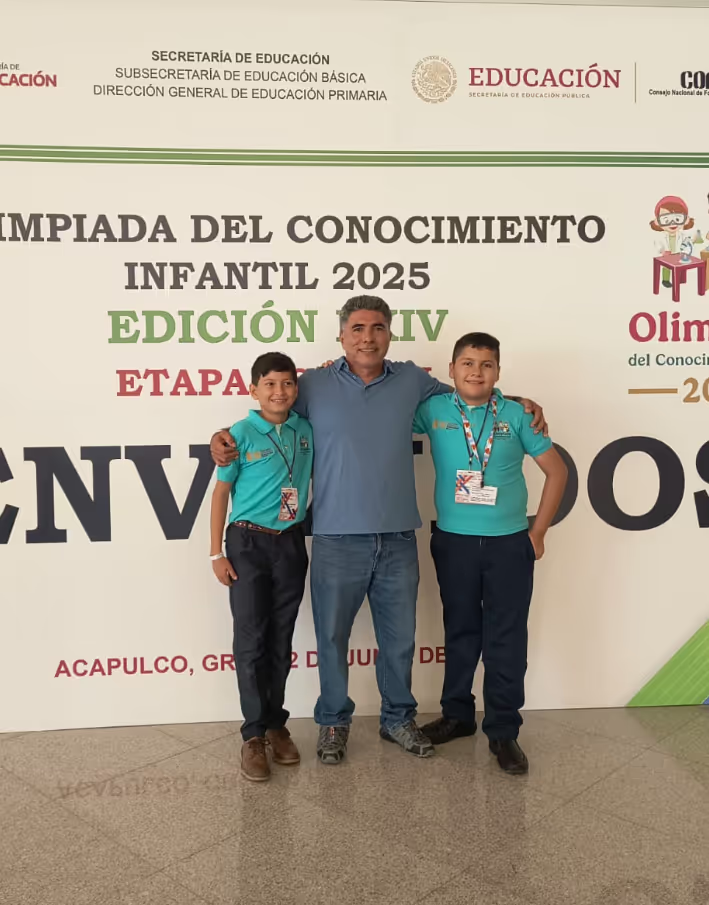
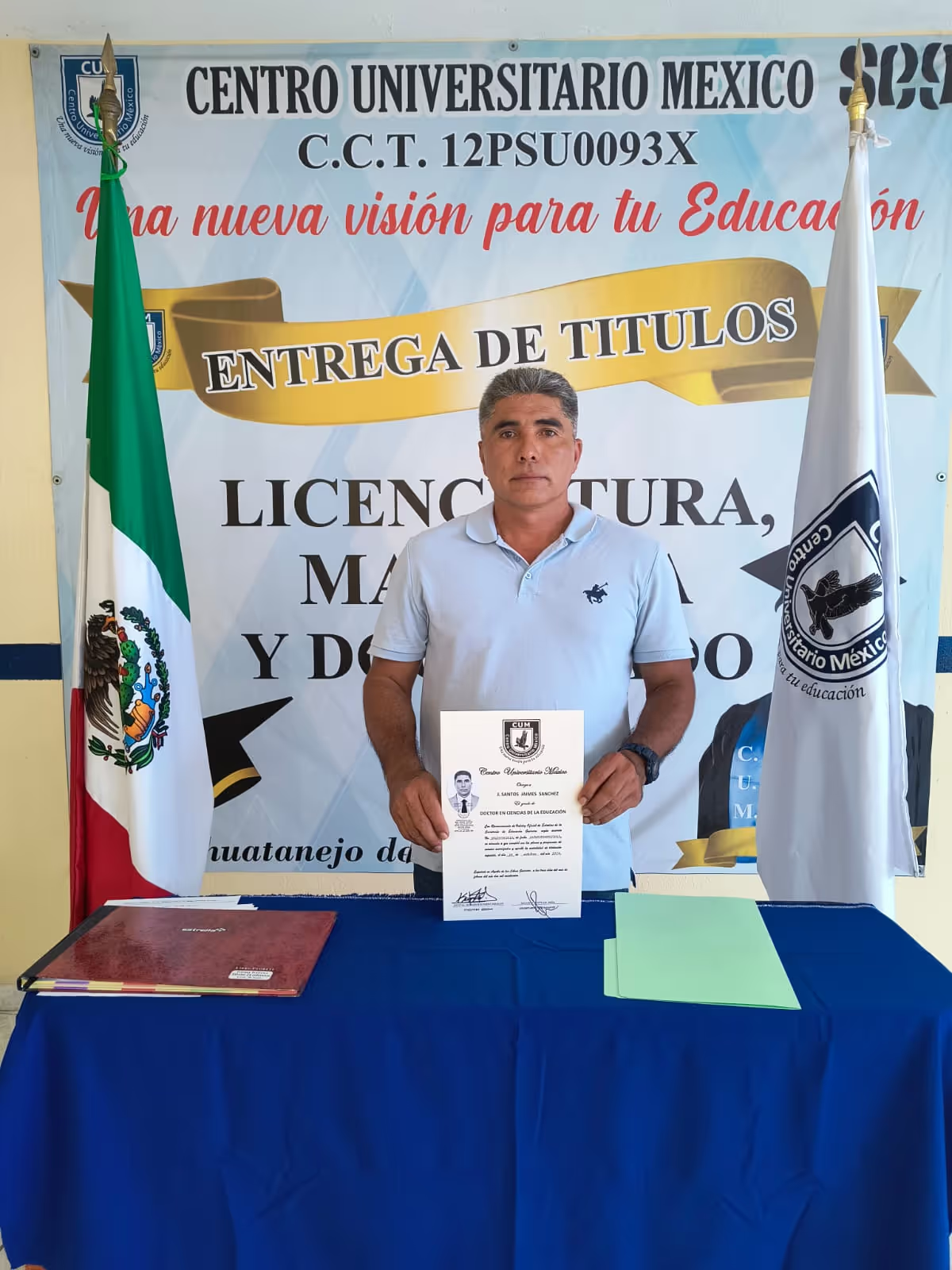
In Part One, Santos took us through his upbringing, how he made his way into education through a lot of hard work and little bit of good luck. He’d grown up poor, the son of a fisherman, and he wanted to have steadier economic circumstances for himself and his own family. Not only did Santos become a teacher, and a fixture in the Troncones Primary School for 25 years, he’s also recently earned his doctorate in education. He has a unique perspective on education and culture in Mexico.
%2017.27.38.avif)
.avif)





.avif)

%20(Spanish)-2.avif)


LOT: What are the strengths of the Mexican educational system?
Santos: After Andrés Manuel López Obrador was elected president in 2018, the government promoted the idea of a new approach to Mexican education, where the main objective of Mexican schools became to guide students in an integrated manner, a manner which also served the citizens of each region as well as the citizens of the country as a whole. The central idea of the new approach is that, as teachers, we need to guide students to be sensitive to social circumstances, to be more humane, more aware of the needs of poverty, more respectful of the problems that arise in life due to discrimination, gender inequality and cultural insensitivity.
There are four formative fields in this new Mexican curriculum. The first formative field is languages; the second is knowledge and scientific thought; the third is ethics, nature and societies; and the fourth is humanity and community. The idea is that through experiencing these four formative fields Mexican students will learn and practice reading and writing, artistic expression, critical thinking, interculturalism, criticism, gender equality and healthy living.
This new approach was drafted by teachers, not by scientists, not by people at a desk, but people at a table. That process involved teachers from urban communities as well as from rural communities. There are three scenarios for each program in the new Mexican curriculum—classroom setting, community setting and school setting. So, the focus now in Mexican education is to provide a more humanistic education. Perhaps that’s due to what is happening in society today. And let’s remember that humanistic psychology is still “new”—it comes after the Second World War, after 1945, through the work of educators and thinkers like Abraham Maslow, who said that human beings must learn to value themselves, to respect each other, to treat each other cordially and not go around killing each other as had been, and sometimes still is, the case.
In reality, in society, there are human beings with an incredible capacity for evil in their heads and hearts, who hold a desire to harm others. They have an animal pattern of life that cannot be removed, that cannot be unlearned. But the new Mexican curriculum aims to do just that—to take that blackness out of your mind’s heart, to put it aside and to promote harmony with others, to try to be a good human being with everyone, avoid confrontation, avoid war because war brings no good. We, as educators, promote peace. That becomes very complicated because it may not be the lesson taught at home. People learn from the time they are born. You would think it’s understood that each parent has an obligation to tell and teach their child that they must conduct themselves in society without hurting others, that when they arrive at schools they should know how to relate to each other, that they should practice values of respect, freedom, equality, tolerance, discipline, love, to get along with each other, to promote good, not evil, to plan for healthy and sustainable life projects for the good of all. That’s not always the case. To me, it’s a marvel that the new Mexican curriculum is set on creating good citizens. That’s a real strength.
LOT: What are its weaknesses?
Santos: Unfortunately, the authorities have certain requirements, certain rules, certain locks. I see them as locks. Like a padlock. Where if you don’t have the key, you can’t open the way, you can’t get in. For example, in my case, with my degrees, I can’t be in just any school. Because I’m an administrator as well as a teacher, I have to be in a school that has at least 120 students for my qualifications to be justified. That is a padlock. It’s a lock that says I have to be in a big school, because that’s the rule.
Here’s another rule, another lock—the Secretary of Public Education has rules that keep the Department of Education from making new schools in the smaller villages. In Troncones, there’s a need for a bachillerato, a high school. It would be wonderful to have a high school next to the sea. Maybe even a school focused on the technological studies of the sea. But it turns out there are rules against it, that there are not enough students for a high school to be built here. Unfortunately, it has to do with economic issues, the money needed to invest in building the spaces, to acquire the land. In Troncones, for example, there would be an enrollment of maybe 50 students. The government doesn’t build schools for 50 students. That is why the education gap gets so wide here. There aren’t the educational opportunities the students need because enrollment is too low. Higher education is only available in cities, in towns that have many inhabitants, many students. The third article of the Mexican Constitution states that every human being has the right to universal education to develop his or her potential. Instead of rules, there should be a focus on giving students the opportunity in all areas of Mexico, not only in those where there are many students. Here, after the telesecundaria, after middle school, there is no more education available. And even the students who travel to Pantla, La Union and Zihuatanejo, who go on to finish high school, there comes a point where they no longer have the possibility of studying close by and they stop studying, growing, rising.
It’s a common story here that the parents don’t have enough money for their children to continue their studies; they cannot afford to pay for the travel, the books, the uniforms and the food that are needed. So instead, the children start to work, they start to generate money from work in construction, in the houses of foreigners, in gardening, in maintenance. The problem is that when the children have “resolved” their life that way, they’re really not ready to make the kinds of choices their life demands. To have money at 14, 15, 16, 17, 18 years old is great, but too often children at that age start to buy this, buy that. They start to get involved in drinking alcoholic beverages and smoking, and since it’s their money, they say, “I can do whatever I want with my life.” Unfortunately, this is one of the consequences of the Mexican educational system not having the capacity to consider places the size of Troncones for more education. All because of a rule, rather than looking at the social need, the need of the community and what the investment in that community could mean.
Thanks to the efforts made by the parents, the effort made by the students, the effort made by the teachers, the Troncones schools were in first place academically for the 2024/2025 school year in the municipality of Coahuayutla, the municipality of La Union and part of the municipality of Zihuatanejo. The issue of education involves those three educational agents–the student, the parent and the teacher. If there is good communication, and good teamwork, then there will be marvelous results. That’s what’s been happening in Troncones, that kind of teamwork. Looking at my circumstances, it would have been wonderful if the Department of Education had left me in Troncones for this school year, but it was not possible because of my degree and my capacity to serve as an administrator as well as a teacher. The authorities don’t see the work it has taken for Troncones to become number one. That the rule is more important than the results, and the needs, of a community is a weakness of the system.
LOT: What's the best thing a student has said about you?
Santos: My students have given me great joy. A while ago, I went to pick up my wife after she played volleyball. When I got there, she says, “Hey, your student, José, sends his regards. He asked me to say ‘hello’ to you.” That makes me feel good, because it means there’s a trust, friendship and connection that’s still there.
Creating a connection with each student is the first thing a teacher should do. Once there is a connection, once there’s a trust, an affection, a true fondness, the respect between the student and the teacher creates a harmony for both of them. With that harmony, when you start to work, the learning begins to flow.
LOT: What is the worst thing a student has said about you?
Santos: Yes, there have been difficult situations. When I first came to work as a teacher, with little experience, not knowing you have to help the child connect with you, I felt pressured to comply with certain content, to stick rigidly to the development and learning processes the system requires you to cover. I had a desire to get the children to learn all the content, and many times I left them a lot of work to finish, apart from what we worked on in class. I told them to finish at home.
Later, I came to understand the pressure I was putting on them, and I said, “I am not going to do that anymore.” I realized then that you cannot and should not stress children. Today, I understand it even better from studying for my master's and doctorate—you should not put too much work into it—because education should be education for freedom, for happiness. As a student, I do not want to be oppressed by my learning, my work. As a teacher, I do not want to oppress my students. If you oppress and repress them, then they’ll get blocked and get sick. There was a little girl who got sick. She got sick from too much work. She went to the hospital with a headache, and she didn’t want to go to school because of the pressure I put on her. It was my wrong pressure, in trying to comply with a plan.
After that, I finally understood that I needed to give the children an education that is structured and sequential, at their pace, at what is right for them, that I needed to engage their curiosity, because children who learn under pressure to pass an evaluation, once they pass the evaluation—a few days go by—everything they’ve learned is forgotten. The American educational psychologist David Ausubel says that teaching is facilitating learning, and learning is the association between a knowledge you already have and a new knowledge. That is learning. As a teacher, I decided to teach for life, not for evaluation. I decided to be more human. The child, the student, is a human being and has to learn to develop skills that will serve them for life. There’s no time to waste forcing right answers on them that they’ll never need to know again.
At that point, I was going to skip the question that was up next on my computer screen. Santos saw me skipping ahead. I asked him a question about Mexican culture. He said, “I will answer the question you don’t want to ask.”
LOT: Okay. Can you describe the conquistadors from an indigenous point of view?
Santos: There’s a book about La Malinche, Hernán Cortés’ interpreter, by the Mexican writer Laura Esquivel, who wrote Like Water for Chocolate. It’s called Malinche: A Novel. In describing the moment when the Spaniards came ashore, Esquivel recounts how the indigenous people–the Mexica, the Mayan, the Tlaxcaltans–saw the men initially in silhouette, looking like their ancient god Quetzalcoatl. Once on land and sitting on top of their horses, those men would have looked like gods—imposing, powerful, speaking an unknown language. The indigenous had no idea those men had two objectives—to evangelize and to castellanize—to make them speak Castellano, the Spanish of the Kingdom of Castile, and to teach the Catholic faith as being the only true religion. Those had been Queen Isabella’s explicit wishes.
Today, I believe that all people can understand what those men really came to do was plunder, to take the riches of the people and the land, for themselves and for Spain. They acted like pirates, especially when they discovered the indigenous people had gold, an element that was not valued here the way it was valued in Europe. The indigenous did not attack the Spaniards. The Spaniards attacked the “Indians” and when they did, the indigenous realized that the Spaniards were not gods, that they bled.
It was a very ugly and very cruel what the Spaniards did. I am the result of their coming to Mexico 500 years ago. Many of the crew for Columbus before them, and many of the men sent by the governors of Cuba and Hispanola in those years were criminals, people in prisons for crimes against society. They were not well-educated; they knew violence and cruelty as a way of life, and these “voyages” promised them a sort of freedom. As outcasts from society, they couldn’t value organizations or value individuals, especially these odd-looking “Indians”. This made for a tragic situation. It is not for me to say that I wish the Spaniards had not come, because if they did not come, I would not exist. But what I am saying is that I wish they had come with other strategies, other methods, of seeking harmony, of wanting peace instead of war, of favoring freedom instead of repression, of engaging in a healthy life instead of in rape and slaughter.
The Spaniards, besides bringing horses, also brought dogs, dogs for war, dogs trained to kill. It’s in our blood to be afraid of dogs, the big ones, the vicious ones. Violence brings more violence. If a mastiff or pit bull comes along, what’s the first thing we do? Do we grab a rock or a stick? Maybe the dog isn’t aggressive, but there we are wanting to defend ourselves. That is how the indigenous came to know the Spaniards, as assassins—assassins who came to kill their culture, repress their religion, rape their women, take fruit and minerals from the land, ruin their freedom and peace. The tribes who helped the Spaniards against the Aztecs, in hopes of a better life, found their trust betrayed. And the betrayal wasn’t only because of war. The Spaniards brought disease with them, smallpox and other infections the indigenous had no defenses against. By the sixteenth century, Europe had gained protection against centuries and centuries of illnesses that the indigenous never had and were unable to resist. It was a biological attack that killed millions, even more than were murdered by war. I have heard it described that the Spaniards were conquistadors, liberating the people from the Aztecs and lifting them up. It was not that, and we are the result of that misguided moment.
LOT: The United States has a 400-year European history. Mexico has a 500-year European history. There’s more harmony between the races here. How does time allow history and attitudes to change?
Santos: You talk about 500 years. In reality, it is many more years. It is from the entire existence of mankind. Indeed, the Europeans arrive in North America and put the blacks they bought to work. It was that unfortunate era in human history where there was slavery, where the sale of human beings was commonplace, fueled by the belief that a white person is of greater prestige and more valuable than a black person, when it’s clear the black and the white are both human beings. History is written by those who win. If only history were written by those who lose. But those who lose are dead; they cannot write.
The Europeans arrived and settled on land that was not theirs. The 13 colonies of the United States came mostly from England, supposedly “discovering” new places to live, work and worship. They came because they were not comfortable in England and did not agree with the systems of government and religion that were established there. They came from a place where supposedly “intelligence” is more developed, and they brought their weapons, their gunpowder, their rifles, a new way of warfare no one here had ever seen before.
Here weapons were made of obsidian stone and arrows. The indigenous lived in complete harmony with nature. They valued things that were far different than what drove the Europeans, the desire for more, the desire for control. And the indigenous did things at their own pace of intellectual development. For example, the Mayans built a very accurate calendar and the Mexica built pyramids that did more than mark a location. That is intelligence. The Mexica also built Tenochtitlan, a large city on a lake, far grander and more sophisticated than Venice, a series of chinampas on a lake, artificial agricultural islands, a bountiful framework for planting and harvesting, a world connected by canoes; a drainage system more developed than anything on the European continent.
The European continent was more developed in killing, and used its intelligence towards killing, toward discovering weapons to take the life of another, towards discovering ways to have more power over others. Here, arrows, axes, sticks were the intelligence of war, nothing anywhere close to the advanced levels the Europeans had. Alexander the Great learned warfare in Macedonia from his father Philip, a king who knew how to conquer, how to go gain territory and power by killing people and taking over everything. That is the culture of the European continent, and they brought it here to the Americas and took over everything.
And, again, this is not a reproach, because thanks to them and their way of doing things, I exist. I speak Spanish but I am not Spanish. I am a mixture of many people. I believe that we should not demonize one thing or the other, but instead we should learn to understand the processes of life and what has already happened, to take the good and put the bad aside, to try to live in harmony within the whole of society.
Our previous president, Andrés Manuel López Obrador, criticized the Spaniards in his speeches, and demanded an apology for everything they came to do in those years. For some authorities, both here and in Spain, it was a laughing matter. For them, what happened back then is a part of history, a process that has already taken place; no amount of apology will set it straight. Again, unfortunately, throughout history, what has counted most is the rule and law of the strongest. In education we have a great challenge to face, which is to ensure that the laws of the strongest do not prevail, and that the laws of truth, justice, values and harmony do prevail. That is the great task we have in education, and not just in classroom education, but also in education at home and in the community, the teaching of understanding—that all human beings have rights and we each have obligations to each other, to contribute to life, and that life deserves respect.
LOT: What is the defining characteristic of Mexican culture?
Santos: Mexican culture is defined by many factors. I don’t know all of them, but I will tell you it is a mix, a blend of different traditions. Look, today we are at October 26, at this time of year, in our indigenous culture, we celebrated the dead. When the Spaniards arrived here, they also celebrated their dead, but on November 1 and 2. What’s come to pass is a blending of the traditions from over there with those we have here. We celebrate the dead now by making altars, a framework of different levels, to honor the deceased and to honor Mictlán, the place of the dead for the indigenous, a world of nine levels. We use cempasúchil flowers [marigolds] just as the indigenous people did, and put out breads and foods and make paths with candles, just as they did.
Here in Troncones, for the last five years, the community has been organizing itself to clean the cemetery at this time of year, and then on November 1 and 2, they go and put candles out for their deceased; flowers and wreaths, too. On those two days, they keep a vigil; they bring music, they go to eat. They make chocolate, coffee; they slaughter pigs. The people go to the cemetery to celebrate, to remember their dead. It’s a celebration that mixes indigenous practices with the beliefs brought here from Europe.
Mexico does that. It takes from other cultures; it takes their celebrations and makes it its own. Even though Mexico is part of the last continent to be “discovered”, now, through information and communication technology, we are connected to the whole world. Our culture is constantly changing, appropriating the practices of other cultures. In Mexico, we have celebrated the Day of the Dead for centuries. Here in Troncones, we have people who celebrate Halloween, who dress up, as witches, Frankenstein and monsters, and go from house to house asking for candy. Maybe our culture shouldn’t do that, but the foreign influence is too great.
The idea of something sweet being given away freely is too irresistible, no matter your age, no matter the expectations it creates between one society and the other—how one group gives while the other gets accustomed to wait to receive. It could be said that the practice of Halloween reinforces a way of life that is not an equal exchange. But it can also be said that right now we are creating a new mixture, combining the ancient indigenous, the medieval Catholic Church and modern Halloween to create something entirely new. That’s Mexico.
LOT: One thing I like about Mexico is its tolerance; Mexican society is extremely welcoming, hospitable. Another thing I like is how people from all over the world come to Mexico to relax. It’s the world’s happy place. What do you think of those aspects of Mexican culture?
Santos: Yes, Mexico reaches the world with that message, “Come, we want you”. That’s part of the warmth Mexico provides, the hospitality. And we don’t have any rules about how anyone enjoys themselves. Like when you’re on the beach, you’re welcome to enjoy the sand and the water anyway you like, in a bathing suit, in pants, as you wish. In Mexico, no one will prevent you from living life your way.
There’s a certain freedom in that, in wanting the visitor to be at ease, to want to return. But that can also be dangerous to a society. That was part of what the conquest brought. From 1521 to 1810, about 300 years, the Spaniards ruled, evangelized and built churches. Franciscan missionaries in those years worked in the villages to teach them how to care for those who were still to come, to prepare for a savior who is still to come. It’s part of our culture now. We welcome; we offer a glass of water, a taco, a place to sleep. Like John the Baptist in the New Testament, we know how to prepare the way for the one who’s to come. That’s our type of hospitality—to make the person in front of you feel good, wanted.
LOT: You work a long way from here right now. Why do you still live in Troncones?
Santos: From the moment I entered Troncones, when I saw the trees as I climbed the hill and then saw the beach when I came off the hill, I thought, “This is a place for me.” I like to dive, not just to take oysters, lobsters and fish, but also to observe. I also enjoy the forest, that feeling of being surrounded by nature and its abundance. There is a lot of life in Troncones, ecologically and socially; there is diversity and there are resources, the characteristics needed for community, for harmony, for individuals to thrive. It’s the right place for me and my family.
After our interview, Santos learned he has been re-assigned to the Lagunillas school. He no longer has to drive four hours each way every weekend to get to and from work. Look for him. Wave. He’s where he wants to be. That makes for a lot of joy and leaves plenty of room for learning.