Troncones’ Water, Part Two
It’s a Jungle Isn’t it?
Editor’s note: Earlier this month we interviewed Alberto Solís Hernández, the secretary of the Troncones ejido, to learn how the ejido manages and distributes Troncones’ most precious resource—its water. It’s tricky. Troncones has a limited water supply, one dependent on rainwater runoff and the ejido’s maintenance of a system of wells, tanks and pipes. The growth of the local population and the lesser rainfalls in recent years constantly put the whole system to the test, especially in the December-to-March “high” tourist season. And after. Until it rains again. Our resident naturalist William Mertz provided us more insight on Troncones’ rain and water usage, and describes what you can do to help the community.





%20(Spanish)-2.avif)



People who come here in the dry season eventually ask the same question, usually while looking at the hills. How can a place this beautiful be short of water?
The trees answered them months ago. Nobody was reading.
This is not jungle. Visitors arrive expecting jungle—tropical, green, dripping, the coast off a postcard—and instead they find brown hillsides, bare gray branches, and a sky that hasn’t produced rain in months. It looks like something died. Nothing did. This is tropical deciduous forest, and the word that matters is deciduous. For six, seven, sometimes eight months of the year, no rain falls at all. The forest does the only sensible thing and drops its leaves. It isn’t dead. It’s waiting.
And almost no one sees it any other way. The visitors come in the dry months, roughly October through April, which are precisely the months this place is at its thirstiest and least green. They miss the rains. They’re not here when the rains come. They miss the flowering. They miss the few weeks a year the hills go the color everyone assumed they’d be. They see us at our driest and take it for normal, and then they wonder, reasonably enough, where all the water went.
It was never here. Not the way they think.
Here is the part simple enough to say in a sentence: there is no more water here than there was when I arrived eighteen years ago. Nothing about the supply has changed. What has changed is everything sitting on top of it.
The land is selling. It has been selling for years—lots, then houses, then condominiums, then hotels, then more hotels, and it has not slowed down. More people arrive every season, and more of them stay. The demand climbs and climbs. The water does not. We keep pouring a larger population into the same finite glass and acting surprised when it doesn’t fill.
One thing has genuinely changed, and it’s worth understanding, because it sounds like good news and is actually the most alarming fact in this whole account. Everything from Manzanillo Bay north to Majahua has been taken off the Troncones town system entirely, and has moved onto a separate line—the one running to a well beside the river at Lagunillas. That shift lifted four hotels and a major condominium project off the town’s strained supply and set them drinking from a different source altogether.
NOT ENOUGH: WHERE TRONCONES’ WATER COMES FROM
It helped. It was not enough.
Sit with that for a moment. We subtracted some of the very heaviest demand there is—four hotels and a condo development—put it on its own river, and the town is still short. That’s not a story about a solution. That’s a measurement of how deep the hole goes.
So why not reach for more of that river water and route the rest of town onto it, too? Because the river isn’t ours. It sits inside a different ejido, and that ejido holds the rights to it. This is not a technicality. Water rights are not water—a river can run full and still not be yours to take. The stretch of Troncones already drawing from it got there through long negotiation, in good faith, and it has been a real help. But that goodwill is mostly spent. Asking the ejido to carry the entire town would mean asking them to bleed their own supply dry for ours—and their river is subject to every shift in rainfall I'm about to describe, the same as everything else here. There is no villain in this. It isn’t stinginess. It just is. They have a river and we don’t, and the distance between those two facts is not something anyone can be talked out of.
So where does our water come from, if not the mountains and not the river?
Start with the mountains, because that’s the assumption that has to go first. It seems obvious: there are mountains, it rains on them, the water has to end up somewhere useful. In some places nearby, it does. In La Saladita, in Pantla, the rain hits the range and sinks into an aquifer—an underground body of water that flows steadily toward the sea—and you can drill a well into that flow and pull from it more or less reliably. A faucet with a mountain behind it.
We don’t have that in Troncones. Our hills run straight back into the Sierra Madre del Sur with no break between them and the higher range. The rain that falls on those distant peaks does us no good at all—it can’t travel down and through to the coast the way it does for our neighbors, because there’s no continuous path for it to take. It falls up there and it stays up there, or it goes somewhere that isn’t here. We are not standing at the end of a pipe. There is no pipe. Whatever water we get, we get where it lands.
CRACKS IN THE ROCK: WISHFUL THINKING
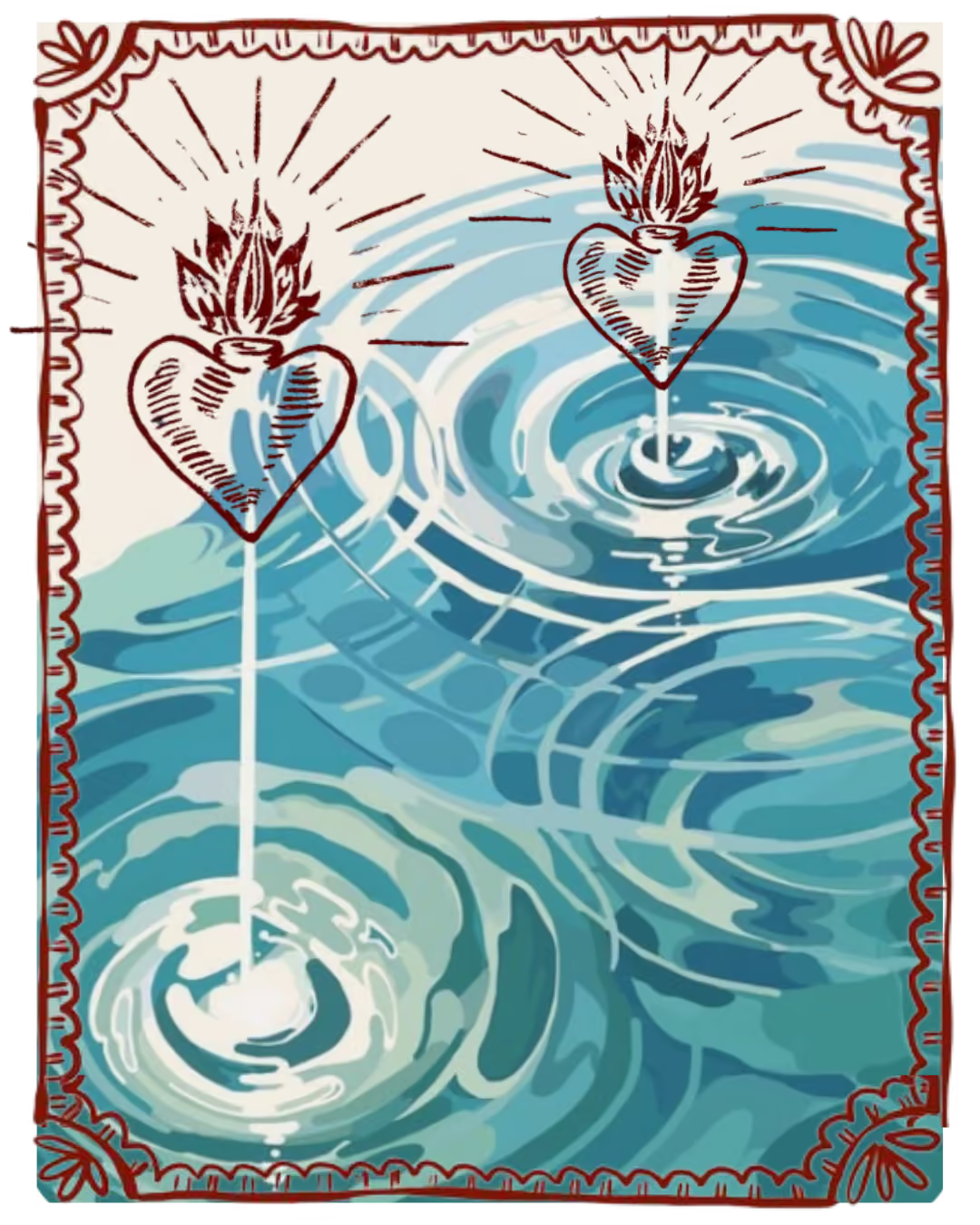
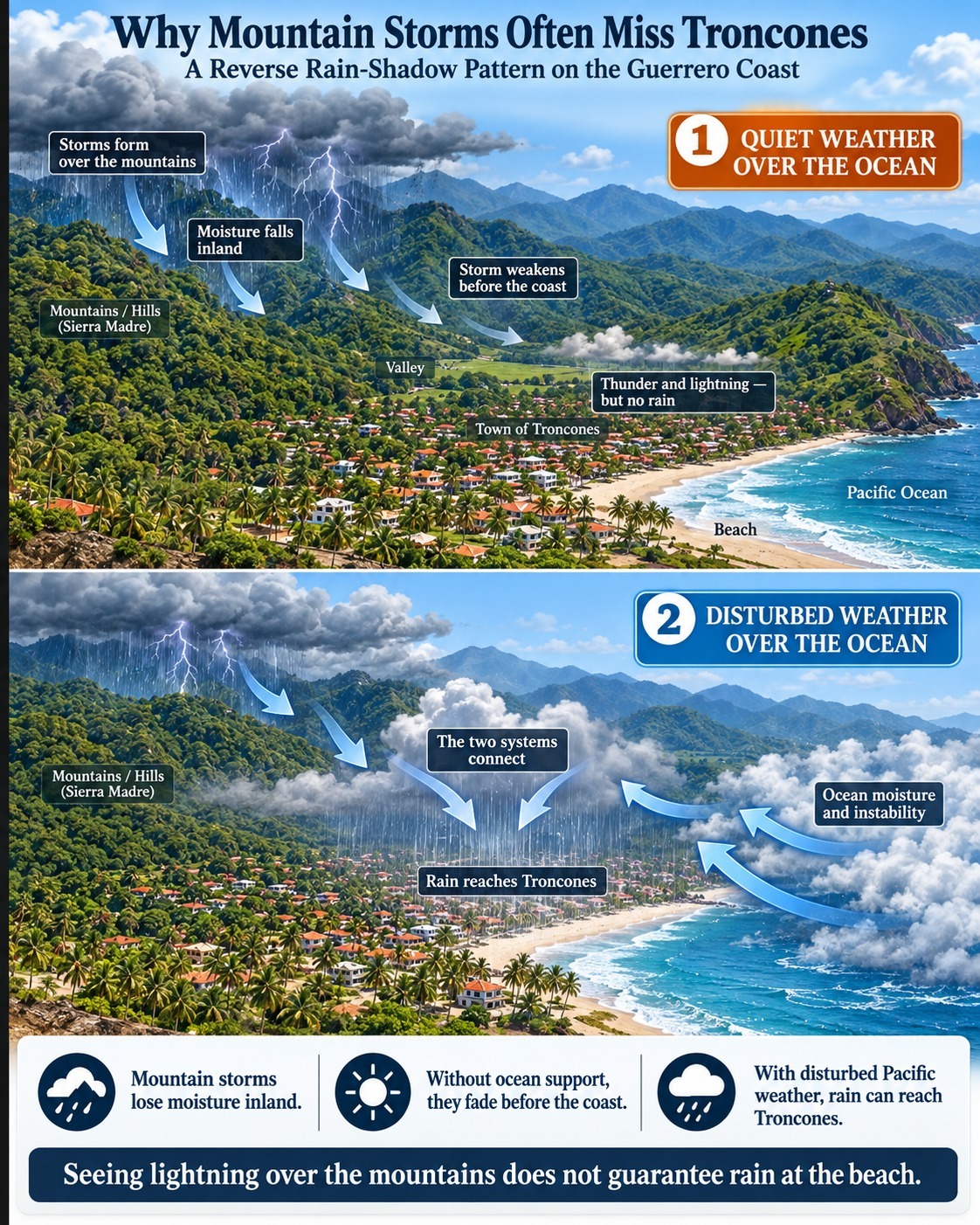
What we have instead is karst. Karst is what you get when water works on limestone over a very long time: not a reservoir, not a lake, not a tidy underground sheet you could point to on a map, but rock riddled through with cracks, fissures, caves, and hollow pockets. When the rains come, water seeps down and collects in those voids—unevenly, filling some and missing others, connected to one another in ways no one here has ever fully mapped. That is the entire water supply. Cracks in the rock, filled once a year, drained by wells.
You already know the limestone is down there, if you live here. It’s the crust on your showerhead, the white scale that seizes your toilet valve, clogs your pipes, and turns a glass of tap water cloudy. That calcium is the rock telling you exactly what it’s made of. Your own bathroom is the evidence.
Which is why “just drill more wells” is not the answer people assume it is. Drilling a well here is not a decision. It’s a bet. You go down ninety meters or so hoping to strike a crevice with water in it, and you might hit a good one, you might hit a poor one, and you might hit nothing worth the diesel it took to drill. Nobody can tell you in advance, because nobody knows the shape of what’s down there. The town’s two main wells sit less than half a kilometer apart, roughly in line with each other—which means, for all anyone can prove, they may be two straws in the same glass, drawing from the same cave and calling it two sources.
More wells doesn’t mean more water. It means more holes punched into the same unknown sponge. At best you find a new pocket. At worst you drain an old one twice as fast. Either way you haven’t added a single drop to what the rains put in the ground—you've only added another mouth to the same finite, invisible supply.
When wells run dry, the imagination reaches for something bigger. Two ideas come up every single time, and they’re worth taking seriously enough to bury properly, because as long as they stay alive people don't have to face the thing underneath them.
The first is desalination. We have an entire ocean right there—why not simply take the salt out? Cost, first: a desalination plant is enormous money, far beyond anything this town has or is likely to have. But say the money appeared tomorrow. You still haven’t solved the problem; you’ve bought a second one. Desalination doesn’t make salt vanish—it concentrates it. What comes out the back end is hypersaline brine, and poured carelessly onto the seafloor it kills what it lands on. So now you own a plant that costs a fortune to build, more to run, and produces a toxic byproduct that has to go somewhere and be somebody’s responsibility, forever. It isn’t a water source so much as a very expensive way to move a problem from the rock to the sea. In fairness, that brine can be managed—diluted, diffused, handled properly—in places with the money and the oversight to do it right. We are not, if we’re honest, that kind of place. The byproduct is toxic mainly when it’s mishandled, and mishandling is precisely what we should expect.
The second idea is a reservoir. Dam something, hold the rain, make a lake to draw from. This one fails before cost even enters the room. You dam a flow—a river, a creek, a dependable stream you can throw a wall across and trap behind it. We don’t have one. There is no perennial river through town, no reliable creek, nothing that runs year-round to be captured. What water we do get vanishes into the rock or races to the sea in a few violent days and is gone. A dam needs something to hold back, and for most of the year here, there is simply nothing arriving. That’s the most damning part, and I’ll leave the pun where it fell. And even if a flow existed: whose land do you flood to make the lake? This coast sits on an active fault and shakes regularly—building a large standing body of water behind a wall is a poor idea in exactly the kind of place where walls come down. Then the money, the maintenance, the question of who is accountable for it in perpetuity. One fatal problem, followed by a line of merely serious ones.
Here is the thread running through all of it. Every solution people propose assumes we have something we don’t. Drill more wells—assumes a body of groundwater with a shape and a bottom. Desalinate—assumes money, and somewhere to put the poison. Build a dam—assumes a river. Each fix is a perfectly good answer to a different town’s problem. They’re solving La Saladita, or Pantla—a place that has water and only needs to reach it. We are not that place. There is nothing to reach.
MORE RAIN, SLOW RAIN: WHAT TO DO
Which leaves the rain. And the rain is the part that’s changing.
Every year the warnings arrive. This is an El Niño year, we’re told; the strongest on record, brace for hurricanes, brace for flooding, worry about the coastline. And every year I stand under the sky they’ve described and write down what actually falls on the roof. It’s the middle of September as I write this—historically our wettest month of the year—and it has rained twice. Both times, lightly. I’m not arguing with the forecasts. I’m just reporting the weather.
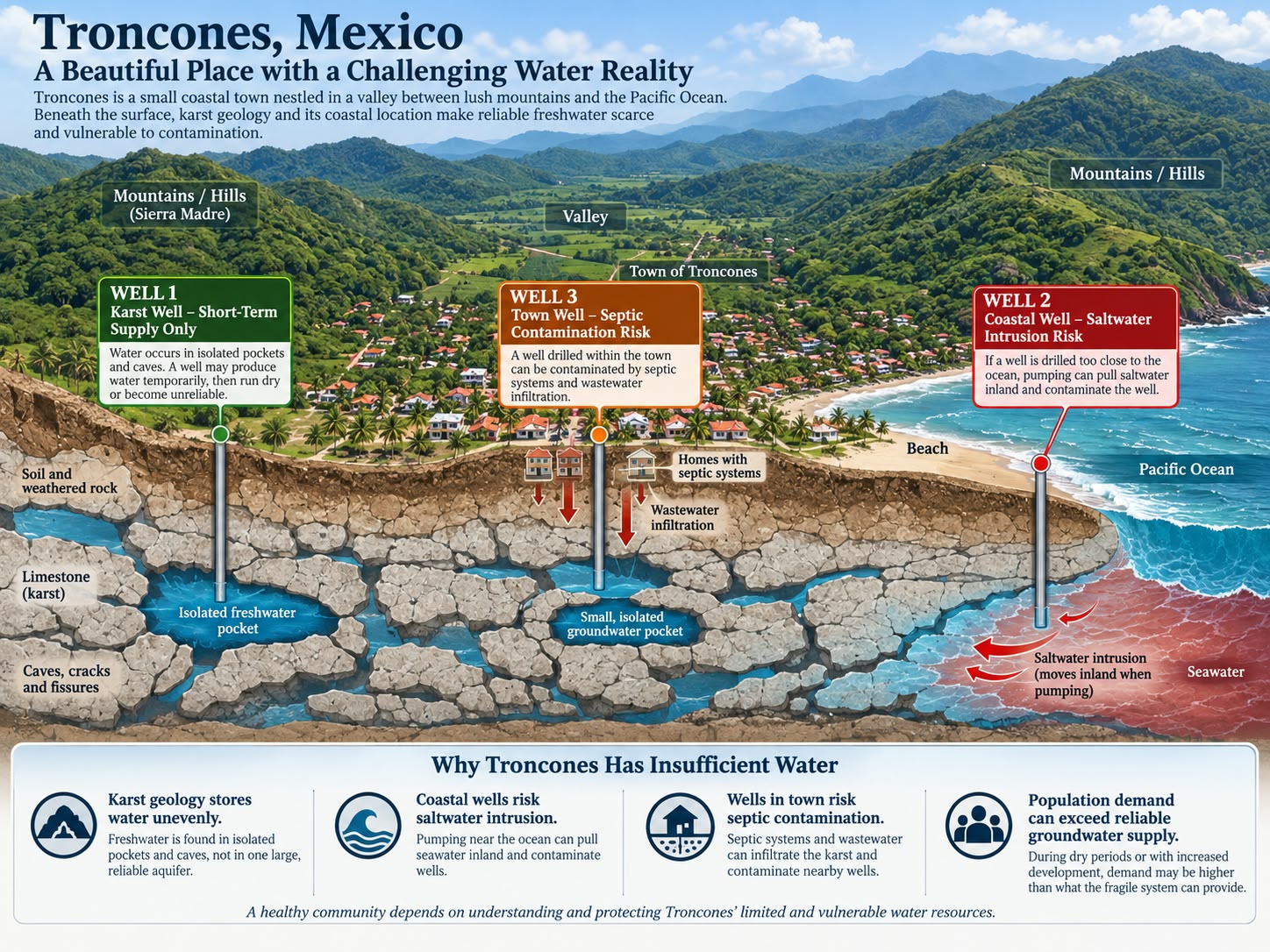
The trouble isn’t only that there’s less rain. It’s that the rain we get now comes in the wrong shape. A karst system needs slow rain—long, patient, days-long soaking that has time to work down through the cracks and into the pockets. What we increasingly get instead is the occasional violent downpour that sheets off ground baked hard as pavement and runs to the sea before the rock can drink any of it. Roughly the same water may fall across a year, but far less of it stays. The geology was always built to drink steady rain, and steady rain is precisely the thing disappearing.
You can watch it happen. The afternoon storms that used to build over the Sierra and roll down to the coast nearly every day in the wet season now die behind the ridge. The thunder still reaches us; the lightning still reaches us—the rain does not. The air is too dry, the ocean isn’t feeding enough moisture back up to meet the mountains, and the daily storm that an entire generation set its afternoons by has simply stopped coming. That isn’t a chart. It’s eighteen years of watching one patch of sky from the same yard.
I won’t pretend to know which forces are doing this, or in what proportion. What I can say is that the predictions keep failing in the same direction, and no one can tell you if or when the old rains will return, or whether they’ll come back in some new pattern that helps or one that doesn’t. That uncertainty is the actual finding. You cannot plan a town’s water around a sky that won’t keep its promises.
So, what do we do?
Honestly, the thing the town most needs is the thing it’s least able to enact: real requirements on new construction—rainwater catchment, wastewater systems that recycle greywater onto gardens instead of throwing it away, planting that suits a dry place instead of fighting it. On paper it’s obvious. In practice it stays a suggestion, because any such rule falls hardest on the people who can least afford to comply, and no one has found a fair way around that. I’m not going to pretend I can regulate a place I can only write about.
What’s left is what people choose to do without being made to.
If you own a home or a lot here, the single most useful thing you can do is catch and reuse water—a cistern off the roof, a greywater system feeding the plants. Watering is where an enormous share of household water goes, and it’s the easiest to take off the well.
And if you’re one of the visitors—here for a week, two weeks, a month, year after year—you have more leverage than you think, though not where you’d expect. Shorter showers and turning off the tap help, genuinely, but they’re small. Your real power is where your money sleeps. A guest who chooses the hotel with cisterns and greywater and a garden that isn’t at war with the climate does more in one booking than a season of careful faucet-turning. Ask the front desk where their water comes from and what they do with it—even when it doesn’t change your reservation, the question itself does something a resident can’t: it tells the business that paying guests are watching. Decline the daily linen and towel change; hotel laundry is one of the heaviest draws there is. And learn to read a bright green lawn in March not as luxury, but as a warning—someone is pouring the scarcest thing this place has onto grass, for the look of it.
If you ever can, come once in the wet season, and see this coast green and flowering and loud with life. You’ll stop thinking of it as a dry place with a water problem and start seeing it for what it is—a seasonal place living inside a hard cycle, at its most beautiful in the months almost no one visits.
There is no clean ending to this, because there isn’t one to have. The rock can’t be re-engineered. The sea’s fixes cost too much and poison too much. There’s nothing to dam. And the rain that fed the whole fragile arrangement has gone quietly unreliable. What’s left is smaller and more honest than anyone wants: catch what falls, ask the hard questions, and stop expecting a beautiful dry place to behave like a wet one.
The trees already worked this out. They drop everything and wait, and when the rain comes, they’re ready for it—no cisterns, no wells, nothing to build. We’re the ones who showed up expecting jungle and started watering lawns. We are living in their forest. We might at least read it.
TRONCONES’ WATER, PART ONE
https://www.laondatroncones.com/live/troncones-water-part-one