When the Black Fin Rises
Orca attack off of PLAYA LA MAJAHUA (IN ZIHUA) makes the news
Our nature writer, William Mertz, heard about an orca going after a baby humpback, did some homework and sent us this report before the attack became a "thing" on social media.
.avif)





.avif)
%20(Spanish)-2.avif)

December 2025 | Troncones Coastline
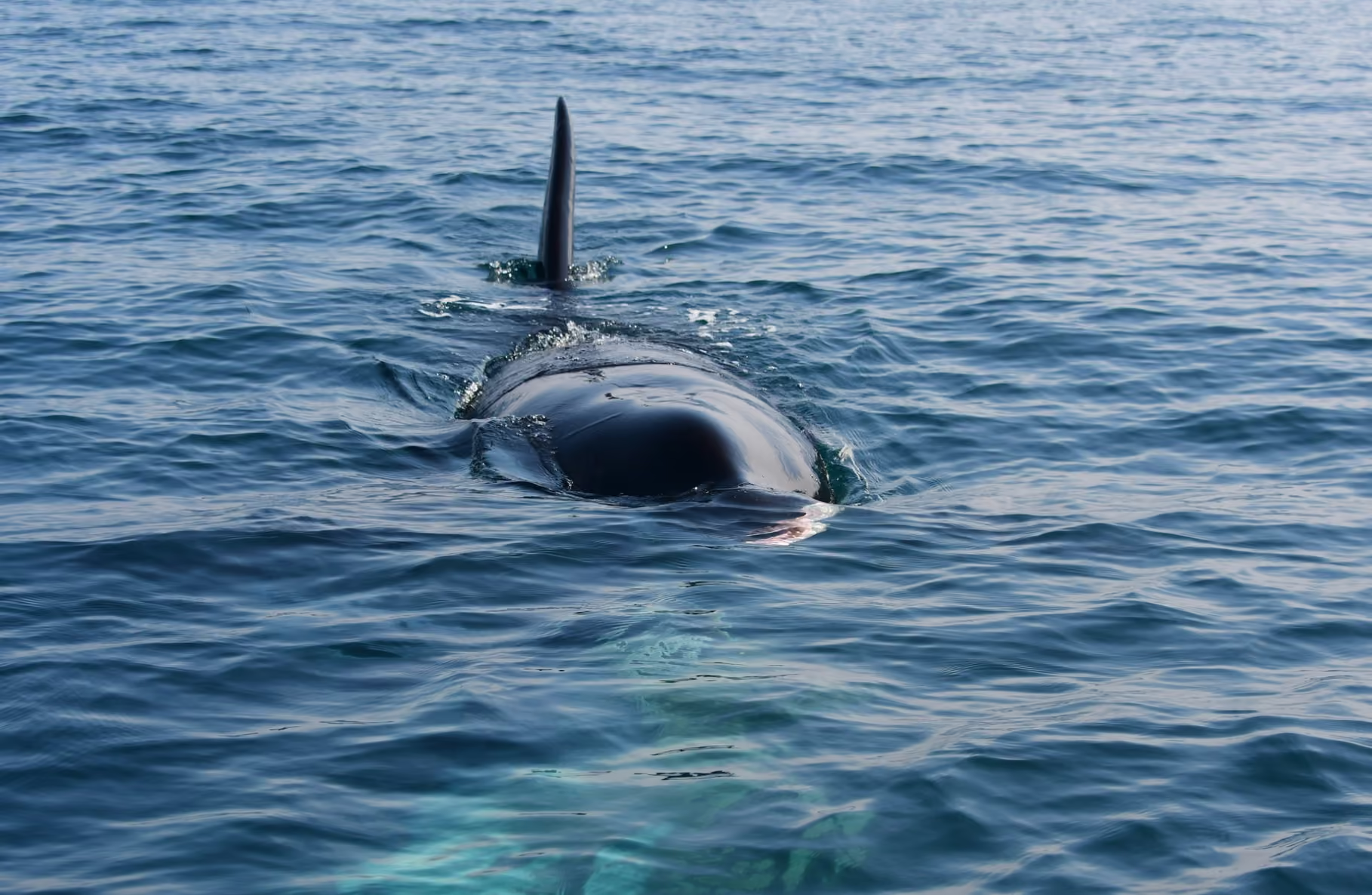
On Sunday morning December 21st, a lone orca was spotted just four kilometers offshore from Zihuatanejo's Playa La Majahua—barely beyond the view of beachgoers sipping their café con leche. But this was no ordinary encounter, and certainly not the photogenic postcard most people associate with whale season. This was an orca who was dragging the body of a humpback whale calf—a fresh kill. And it was feeding.
The moment was documented by Whales of Guerrero, a local research and conservation group, who quickly mobilized a survey boat after the sighting was reported. What they found wasn’t just a rare visitor—it was a glimpse into a different kind of ocean. One where the stakes are as high as the waves.

THE HUNTER
Orcas—Orcinus orca—are not all the same. Across the globe, scientists recognize distinct ecotypes of these apex predators. Some live in tight-knit pods and feed mostly on fish, known as “Residents.” Others, like the orca spotted here, are classified as “Transients” (or Bigg’s orcas, after researcher Michael Bigg). These orcas are specialized hunters of marine mammals—seals, sea lions, dolphins and, yes, whale calves.
Unlike their more vocal cousins, Transients move in small, stealthy groups. They don’t echolocate when hunting. They don’t play. They strike.
For an orca to show up in Guerrero isn’t unheard of, but for a Transient to successfully take down a humpback calf just offshore—and for it to be photographed mid-feed—that’s exceptional. It’s the kind of event that leaves a mark, not just on the researchers, but on the mythology of a place.
A NURSERY NO MORE?
The waters around Zihuatanejo, Ixtapa, Troncones and Saladita are part of a well-documented breeding ground for humpback whales. Every year, from November to March, mothers migrate from the cold feeding grounds of the north to these warmer tropical shallows to give birth and raise their calves. Locals know the rhythm. The soft roll of a mother’s back offshore. The slap of a playful fin. The sudden burst of a calf’s breach as it learns the strength in its body.
But this event reminds us—nurseries attract predators. Humpback calves, despite their size, are vulnerable: slow, naive, and bound to their mothers for protection. And one mother alone cannot fend off an orca, no matter how fiercely she tries.
NOT A TRAGEDY—A WARNING SIGN OF HEALTH
It’s tempting to see this as a loss. As a brutal act in what should be a safe haven. And emotionally, it is. But ecologically? It’s a milestone. Predators don’t return to dead oceans. They follow life.
The presence of a hunting transient orca suggests this coast is once again rich enough—alive enough—to support complex marine interactions. The food chain is long. The drama is ancient. And this time, we caught it in motion.

WE CRAVE THE BREACH, NOT THE BLOOD
Tourism tends to romanticize whale season. It’s marketed in brochures: mother and calf silhouetted at sunset, tails dripping gold into the Pacific. But the truth of these waters is deeper, darker. And more powerful.
Nature doesn’t owe us comfort. Sometimes, it gives us orcas.
And if we’re paying attention, we won’t look away. We’ll witness. We’ll learn. We’ll remember that the ocean isn’t here to entertain us. It’s here to endure.
NOTES FROM THE FIELD
This event was documented and confirmed by Whales of Guerrero, a research and education organization based in Zihuatanejo. You can follow their work at whalesinmexico.com or on social media.
Viewer discretion is advised: images of the orca feeding on the calf may be disturbing to some. These are available through official channels for research and education only.
(A POETIC) FINAL WORD
The black fin came like a shadow on the water—quick, clean, unapologetic. And in its wake, we’re left with the truth: this coast is wilder than we remember. And thank god for that.
LINKS
whalesinmexico.com
facebook.com/reel/1166726472335117