Maria Fernanda Nava Merino: Surf Witch
La Onda’s social media director looks back at her last year and to what’s ahead for Troncones—and reveals some of the magic of the Tarot
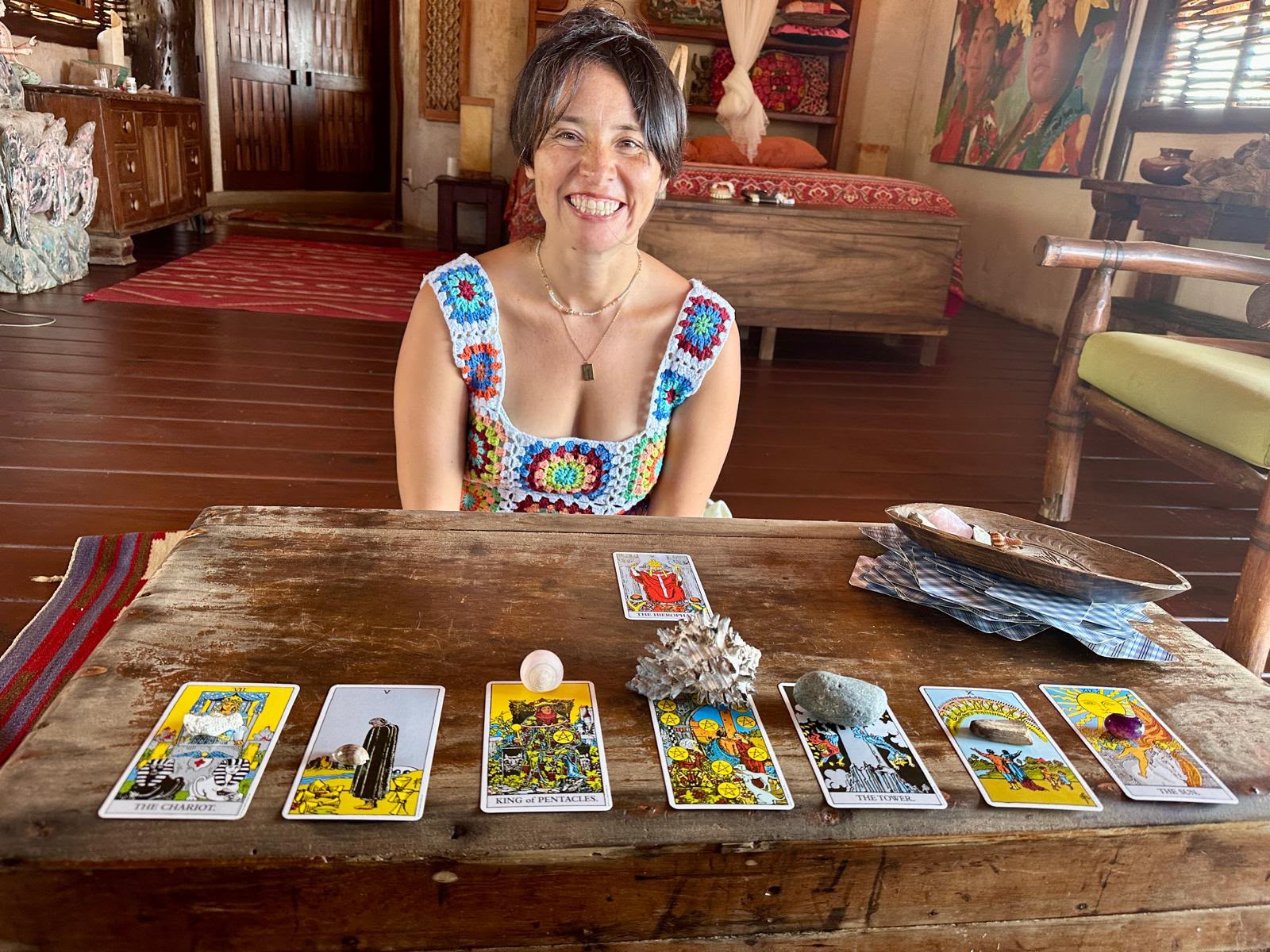
When we started planning interviews for La Onda Troncones last year, Aura asked me to put “The Surf Witch” on my list. One day there was an art workshop and tarot reading going on at Quetzal, and Aura said, “That’s her!” That’s who? When we started to plan out how La Onda would roll out its social media, Aura said, “We have to talk to this woman who lives in Troncones, who I follow on Instagram. She’s got a yoga studio, she’s doing tarot collages and she’s a graphic designer.” Ok, sure. When we met, I had no idea the person in front of me was someone I would be talking to almost every day for the next year—and that she was about to build a house and become a mom—and that she was the Surf Witch, too. Who is she? She’s in my phone as “Fer”. Aura has her as “Maria”. Meet Maria Fernanda Nava Merino. We couldn’t have done La Onda Troncones without her.
%2017.27.38.avif)
.png)





.png)
%20(Spanish)-2.avif)
LOT: Where did you grow up?
Fer: I grew up in Guadalajara, but I wasn’t born there. I was born in Puebla. My mom is from Puebla. My dad is from Jalisco. We stayed in Puebla until I was 5 or 6 years old, and then we moved to Guadalajara. I feel like I’m more from Guadalajara than from Puebla because I don’t remember anything about Puebla. But I was registered in Tapalpa. That’s a town in the mountains close to Guadalajara, the town my dad is from.
LOT: What does “register” mean?
Fer: Like on my birth certificate. My dad wanted to register me as being from Tapalpa, like him. So, I was born in Puebla, but I’m registered in Tapalpa and I was raised in Guadalajara. There’s a whole identity crisis situation there.
LOT: So, the identity thing goes way back.
Fer: Yeah, also with my name. In Guadalajara, Maria Fernanda was a very popular name, so at school, I became Fernanda. My parents called me MariFer. And when I arrived here, everybody started calling me Maria, even though I never called myself Maria. But I just let it be. So, people know me here as Maria, and in Guadalajara as Fernanda and in my house as MariFer.
LOT: What kind of work did your family do in Guadalajara?
Fer: My dad specializes in floriculture. That’s agriculture, but with a focus on flowers. He does ornamental flowers, plants for decoration, stuff like that. He has a greenhouse in Tapalpa and he and my sister have a business of growing flowers and selling them to flower shops in Guadalajara. My mom has a flower shop, but my mom sometimes doesn’t buy her flowers from my dad because she needs to have more variation; she needs to buy more.
LOT: How did you happen to come to Troncones?
Fer: I had a friend who was looking for a place where he could surf and skateboard. There were not many places where that was possible. He researched and found the bowl at Mi Casa, Su Casa [now Hotel Tres Santos]. The first time I came was in 2010, more or less, to surf, even though I hadn’t started surfing yet. We started meeting the locals and the surfers here, and everybody started saying, “Go to Saladita. Oh, go to Rancho”. So, we started getting to know the area. We fell in love with Rancho and we started coming every 15 days, every holiday and sometimes every week, to surf. That’s how I met most of the local people.
LOT: What made you stay in Troncones?
Fer: A lot of people see Troncones as a place to retire and I was not very attracted to Troncones at the beginning. But I had a friend who stayed here for six months, and she met the people at Present Moment. She was teaching there briefly and she asked me, “Why don’t you go to Present Moment? It’s not that bad.” And I did, and after I got to know the owners, they had an opening for something like “wellness manager”. And I thought, “Like, why am I going to go to Troncones, live in a wave paradise, and be tied to an office. That’s torture.” Then, they called me to cover yoga classes for two weeks for some teachers going to a wedding. At first, I said, “No,” because I had a flight, a ticket to San Jose del Cabo. I don’t know why, but one day I woke up and I was like, “Los Cabos is going to be there forever. Why am I going to reject this?” So, I stayed for those two weeks and after that, I filled in for about four months, and now it’s been like eight or nine years that I’ve been living here.
LOT: How did you become known as the Surf Witch?
Fer: I’m a friend of Craig Johnson, one of the [surfboard] shapers here in Troncones. I used to surf with him and Scott, another teacher from Present Moment. One time, I went away—this is right when I started learning about tarot—and Craig sent me a message saying, “You are a witch. Mexican folklore is full of witches and most of them are from Guadalajara.” He said that every time I left, the waves wouldn’t work. He called me a “surf witch”, and that I must be a good one, because every time I came back so would the waves. That’s how the name came around, from Craig.
LOT: What attracted you to the tarot practice?
Fer: I earned a master’s degree in the rhetoric of the image. People are more familiar with the rhetoric of speech, that when you speak you use different forms, like metaphors or hyperbole, that you use different tools to tell a story or to create an argument. It’s the same with images—people and companies use them to create messages—and that’s what I studied in my master's degree, using images to create messages. One semester we studied psychoanalysis and my teacher brought up the tarot as a way to interpret the unconscious collective, using archetypes, like the archetypes in the tarot cards.
I had a friend who used to read the tarot cards for us. He was super good, and he was a mathematician, someone who usually doesn’t believe in any sort of woo-woo thing. Whenever my friends from the master’s degree program got together, he’d read the cards for each of us. And every time we had a question or a crisis, we’d always go to the tarot. That was like in 2009, but I didn’t know how to read the tarot back then. I learned during the pandemic, in 2020 or 2021, when I met a woman doing tarot workshops online. She taught me how to read, and then I started doing readings at Present Moment for guests, trying on my own. I don’t do divination, telling people what’s going to happen to them. My approach to the cards is from the image—from the symbols and their messages—what each image represents, what ideas and experiences the cards are expressing. Anybody can have a different interpretation of the same card, according to what’s happening in their life—some reaction or rejection or acceptance—that comes through the image and the symbols. To me, that’s more interesting than divination, and more appealing than trying to figure out the future.
LOT: What are the cards teaching you?
Fer: Each one has a different learning. There are major arcanas, the named cards that express strong themes that everybody can relate to, like The Fool, The Hermit, The Devil, The Moon and The Sun. Then there are minor arcanas, the suit cards—cups, pentacles, wands and swords—that represent aspects of everyday life, like maturity, creativity, logic, emotions and material stuff. There are so many things in every card. They are so expressive. There’s always a message. It’s like a form of guidance, for each day or each month or each week—something to remember, to reflect on, something to connect to.
LOT: How did you hear about La Onda Troncones?
Fer: I started doing collage workshops with the tarot, and I was posting about it on Instagram. Aura contacted me to see if I wanted to do some kind of tarot stuff for the La Onda project. Then she found out I was a graphic designer, and that’s how everything started connecting, that’s how everything started.

LOT: What attracted you to what Aura and I were trying to do with La Onda?
Fer: This area is like an incubator full of special personalities and characters. There are a lot of stories to tell here. People don’t even realize how rich this area is in its diversity, how things are happening in this town even when it seems like a ghost town, when it seems like there’s nothing happening—there’s stuff you don’t see on the surface—but then you go around every corner and you find something interesting.
At the beginning of living here, I didn’t know this area would be so rich, so full of stories. With every story, you start noticing, “Oh, wow, this person has a path that everybody can learn from.” It’s easy to see people every day on the street, but it’s not so easy to get to know them “deep”, to find out what’s behind their story. At the start of La Onda, I didn’t know how those connections would come out. It surprises me more and more and more how everybody has a story to tell.
LOT: What’s been the most unexpected part of La Onda Troncones for you?
Fer: That sometimes you don’t even know who you are talking to. You go to the store and you see somebody in their chanclas [flip-flops], super cool and relaxed, but they have a huge story behind them that you never knew. The good thing is that there’s been space for everybody’s voice in La Onda—the foreigners and the people who are locals, the ones who built this place. They are the ones who opened the door for all of us to come here, to stay here, to live here. When Troncones opens its arms to you, it’s easy to stay. There’s an acceptance in this community. They don’t reject people from the outside. You can see that every day on the street, how everybody says hello to you and how you get to know every person in every store, how you get to know their names. And in La Onda, it’s cool to really get to know these people, to go deep into their stories, because usually you don’t have time to interact with everyone so deeply. I didn’t expect how La Onda would make those stories so easy for everybody to know.
LOT: A year is a long time, and it’s also not a long time. What’s changed for you this past year?
Fer: Personally? So many things have happened for me here that I feel like this place is more like my home. Right now, Troncones feels more like home to me than Guadalajara. I feel like I’ve really established my roots here, especially this year having a house and building a family. Troncones is starting to become more and more like a place where I will be for many, many years. So, this year, for me, living in Troncones has become more real.
LOT: What’s been the most unexpected thing about being a mom?
Fer: [Laughs] Everything. I never thought I’d be a mom. I wasn’t looking for it. It wasn’t some expectation I had. My dad always told us, “Go travel, go study, go learn, go explore. Have children if you want to.” There was not the traditional parental push to get married and have children, and all of that. My family has never been like that with anybody. I’m the youngest of my sisters, and I’m the only one who’s had a baby. I’m 41, so I never thought I’d be having a baby. Now that I have one, it’s like everything is unexpected. Everything. It’s tiring, but I’m enjoying it, learning from it. It’s connecting me more with the “presence” that you practice in yoga. But in this practice, you really need to be there. You need to be present. You need to be attentive. It’s a very deep practice.

LOT: When are you coming back to La Onda?
Fer: I don’t know. Maybe once my baby and I get to know each other better, when we know each other’s rhythms for sure. Right now, my moments to focus on things like work are very short. I cannot do more than be present with my baby. But I hope that soon, there is space for more stuff.
LOT: My last question is sort of related to tarot. I was wondering if you could pull cards for La Onda for the magazine’s anniversary, and for Troncones for this “busy” season. Would you consider doing that?
Fer: Ok. I have the cards over there.
LOT: What do I do?
Fer: Every time I do this with people, I don’t use the cards. I let the people use the cards. Take them in your hands. Get both of your feet fully on the ground. Close your eyes. Watch your breathing and be present. Get rid of everything that can distract you from this moment. Exhale all those distractions. Try to be in connection with the deck and start to feel like the cards are an extension of your energy, the energy of whatever you want to experience. Okay? Bring to your mind to an intention, to the question, that you want the cards to respond to. Repeat that intention a couple of times so the intention doesn’t change. You’re going to ask the cards to give you a message that is clear, that is positive and beneficial for you, and for all of the people involved with your intention. Okay. Now that you’re being very present, you’re going to start shuffling the cards in any way you want. Until your intuition tells you, “That’s it”. You decide when you feel it.
LOT: [Pausing, after shuffling.] Okay.
Fer: You’re going to pull one card or three cards, however many cards you want to pull. But first, place the deck face down and spread out the cards. Some people have a sensation of which ones to pull. Pick the ones you want, the ones you feel drawn to, and place those face down in front of you. You’re going to turn them over one at a time, and let them tell you what to remember from before, what to keep in mind for the present and where to look ahead.
LOT: [I picked three cards, asking what we should keep in mind as we continue developing the La Onda project. Those three were in front of me face down, left to right. Fer asked me to turn over the first one, the one on my left.]

Fer: The Nine of Cups. There are different symbols in each card. The cups express the functions of the emotions, of relationships and your connections with other people. The number nine is the number of the hermit, and the hermit is always an invitation to go look within, to the real desires of your soul. In this case, you see a person sitting, more or less waiting for what’s coming, like there’s something to unveil behind him—that’s the curtain behind him—under the cups. So, this card is a reminder of the process of discovering the types of connections and relationships you wanted to create when you first started the project, to remember that moment when you didn’t know how it would go, when you were reflecting on what it might be like to reach out to the community.
LOT: [To myself: That was a scary time a year ago—the moment of starting La Onda, and trying to find writers, photographers, advertisers, people who would help us create something no one had ever created before. I turned over the next card, the middle card.]
Fer: Temperance. Temperance is a card about moderation, about finding the perfect balance, like when you temper something when you’re cooking, that it’s not too hot, not too cold, that you find the perfect temperature. So, this card is a reminder to find that sweet spot in between—in balance, in the middle—that place where you can find an equilibrium. It’s a reminder to avoid going to extremes. In the tarot, the card before Temperance is The Devil, and the devil wants you to go to excess, to go from one extreme to the other. And maybe that’s what the project needs now—temperance—not too much of that, not too much of this—a steady mix, a good balance.
LOT: [Thinking: So maybe we don’t need to worry so much about how we’re going to make this La Onda thing work. Maybe we should keep on trying to find a sweet spot, the best combination, in everything we’re doing. Next card. The future.]
Fer: The Lovers. The Lovers are a card that speaks to the harmony that’s created when two different energies connect and become complementary energies. So, it’s like pointing you towards the opportunities that can come from connecting with new people or with other energies that may even be opposite to your energy, in the way feminine and masculine do. You can see the woman and the man—and the angel protecting everything under the sun—the flames in the tree of desire behind the man, and the fruit and the snake in the tree of knowledge behind the woman. It may be a suggestion to consider what can be generated, what happens, when two different energies get connected, like when the yin and yang connect and create a wholeness. It goes back to wanting to connect emotionally to the people in the Troncones and Saladita area. And now, it’s like finding that balance in the project, and then to see what else can be created by connecting with new or different energies. What are the possibilities?
LOT: Wow. That’s a lot to take in. What if I draw three more cards to see what the end of 2026 and the beginning of 2027 will bring to Troncones?
Fer: Ok, yes. Let’s do that.
LOT: [Shuffling, spreading, pulling, placing cards face down] Okay, so this is for what the busy season will bring to Troncones this year. The Page of Cups.

Fer: See how the fish is coming out of the cup? Did you know the Page is a figure of the court? The Page, the Knight, the Queen and the King. They’re the court and they speak to the maturity of a situation or a circumstance, with the Page being the youngest, “new” and representing the early stages of a project. Immaturity sometimes brings you the possibility of being able to be surprised. Like, by the fish. And the cup, again, is the function of the emotions and relationships and connections. Here, The Page is in the element of water, of flow, redemption and change. This card is pointing towards being open, to being surprised by what new connections, new emotions and new relationships can bring.
LOT: Okay. [Turning over the second card.] The Hanged Man.
Fer: A lot of people get scared with this one, but they don’t realize that he’s hanging from his foot, and that his head is illuminated. This is a card about changing perspectives and seeing everything from a different point of view—like, being open to seeing things with new eyes. This card also has the heart above the head, and putting the heart first like that lights up the head. Remember when you were a child, and you’d climb a tree and hang from your feet? Then you remember seeing something familiar in a completely different way, and that it was fun. That’s the spirit of The Hanged Man card.
LOT: Maybe it’s the spirit of Troncones, too. [Turning over the third card.] The Page of Wands.
Fer: The Page, again, symbolizes something new, unexpected, like the connection to fire, the flame in his hat. There’s a spark that starts everything, and there’s a process to learning how to use that spark. Until you learn how to use it, it’s best to stay calm, steady. See how The Page is looking at the wand? He’s reflecting on what’s in front of him. He’s not being reactive. He’s observing. He’s being a reminder not to rush after the new things that are to come, even things that may be very exciting. It’s another reminder to let the heart lead, to see things from different perspectives and to allow for surprise and joy with whatever’s happening.
FER’S IG LINKS
Yoga: https://www.instagram.com/bhavana.estudiodeyoga/