The Yellow-crowned Night Heron
The Bird You Walk Past Every Night
There is a heron standing at the edge of someone’s pool right now. It has been there for an hour, motionless, doing what looks like nothing. In the morning it will be gone, and whoever owns that pool will never know it was there. This happens every night in Troncones.

.avif)





.avif)

%20(Spanish)-2.avif)





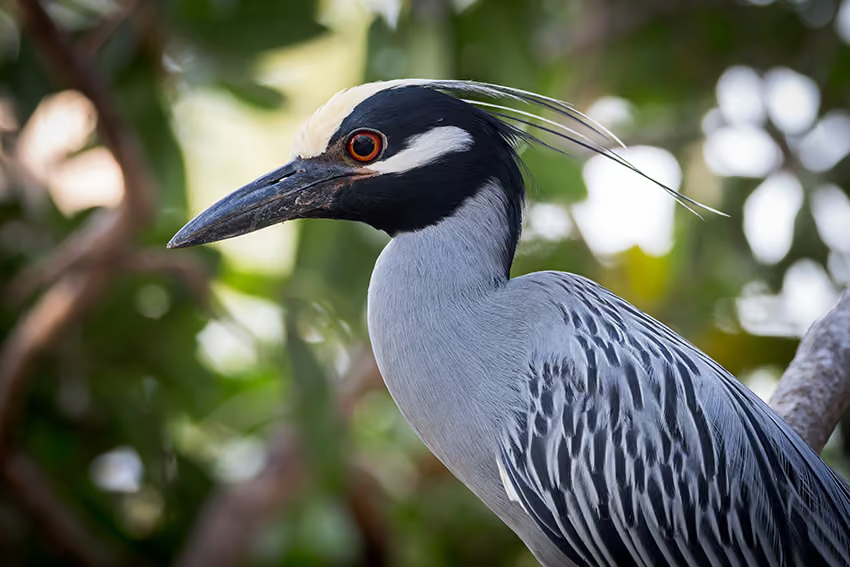
The Yellow-crowned Night Heron [Nyctanassa violacea]—called garza nocturna coronada in Spanish—is one of the most commonly seen birds along our coast, and almost certainly one of the least looked at. It stands on the beach at dusk. It patrols the beach road after dark. It perches in the mangroves with the stillness of something that has decided the world can come to it. Most people who have lived here for years could not tell you its name.
Troncones is home to three species of nocturnal heron, each worth knowing. The Black-crowned Night Heron is arguably the more dramatically beautiful of the group—a stocky, contrasting bird with blood-red eyes that some of us find more striking than its yellow-crowned cousin. The Boat-billed Heron is something else entirely: a strange, wide-billed creature that looks like evolution was improvising, and is fascinating for exactly that reason.
Both the Black-crowned and the Boat-billed follow the same general pattern—large eyes built for low light, a preference for mangroves and estuaries, more active at dusk and dawn than during the day. Both deserve their own articles. But today belongs to the Yellow-crown.
The name sounds like a mistake the first time you hear it. Yellow-crowned? The bird you see on the road at night is gray and black and white, with a pale head that shows almost no yellow at all. File that away. We’ll come back to it.
The large eye is the first thing to understand about this bird. It’s not incidental. A Yellow-crowned Night Heron’s eye is disproportionately large for a reason—it’s optimized for gathering light in conditions where most birds have gone to sleep. This is a creature designed for the hours between dusk and dawn, for hunting in the dim margins where the jungle meets the road and the road meets the sea. When you see one frozen on the beach at 6 am, it’s not an early riser. It’s a night shift worker heading home.
Crepuscular is the technical word for that lifestyle—most active at dawn and dusk, though genuinely nocturnal as well. You can see them during the day, roosting in the shade of a mango tree or standing half-asleep at a pool’s edge. But the animal in its element is the one you catch in your headlights on the beach road at 10 pm, standing in the middle of the lane with no particular intention of moving.

It’s waiting for crabs.
The cangrejos—land crabs—are one of the defining dramas of Troncones that most visitors never notice. Several species share our jungle and beach margins, ranging from small ones the size of a US quarter to mid-sized animals as big as your fist. Then there are the moyos—the large, spectacularly colored crabs that emerge at specific times of year, with claws that can span the width of a hand. The moyos may be outside the night heron’s practical hunting range. Everything else is fair game.
The crabs move at night, crossing roads and open ground on their way between jungle and ocean. The herons know this. They position themselves accordingly.
What happens next is not delicate. The heron strikes, seizes the crab, and then slams it—hard, repeatedly—onto the road surface until the crab’s legs stop working. This is not cruelty; it’s efficiency. A crab with functional legs is a crab that can run or fight. A crab without them is a meal. The heron hammers until the crab is manageable, then eats it. If you have ever found a scattering of detached crab legs on the beach road in the morning and wondered what happened, now you know.
Watch the droppings along the road and near the mangroves. Crab shell fragments, consistently. These birds have made a decision about what they eat, and they are committed to it.
The pools? That is something more instinctual than strategic. Yellow-crowned Night Herons evolved around still and slow-moving fresh and brackish water—mangrove edges, estuaries, quiet lagoons. A backyard pool in Troncones apparently registers as “close enough”. They drink from them. They may pick off the occasional gecko or insect that falls in. Mostly, I think they simply cannot walk past standing water without stopping. The instinct runs too deep. Whatever the reason, if you have a pool and you live near the beach, you have almost certainly hosted one of these birds without knowing it.
Now for the secret.
Around May and June, something changes. The Yellow-crowned Night Herons that spend their days sleeping in the shade and their nights slamming crabs on the road begin to feel a different pull. They move toward the estuaries—places like Playa Linda, where the water is calm and the vegetation is dense and the trees hold many nests at once.
What happens there most people in Troncones have never seen.
A “rookery” is a colonial nesting site—a place where multiple species of waterbirds congregate to breed, sometimes in extraordinary numbers. The rookery at Playa Linda hosts spoonbills, Wood Storks, Snowy Egrets, Cattle Egrets, Black-crowned Night Herons, Green Herons, and Yellow-crowned Night Herons, all nesting in proximity, in various stages of courtship and incubation and chick-rearing simultaneously. It’s loud. It smells. It’s one of the most alive places on this coast.
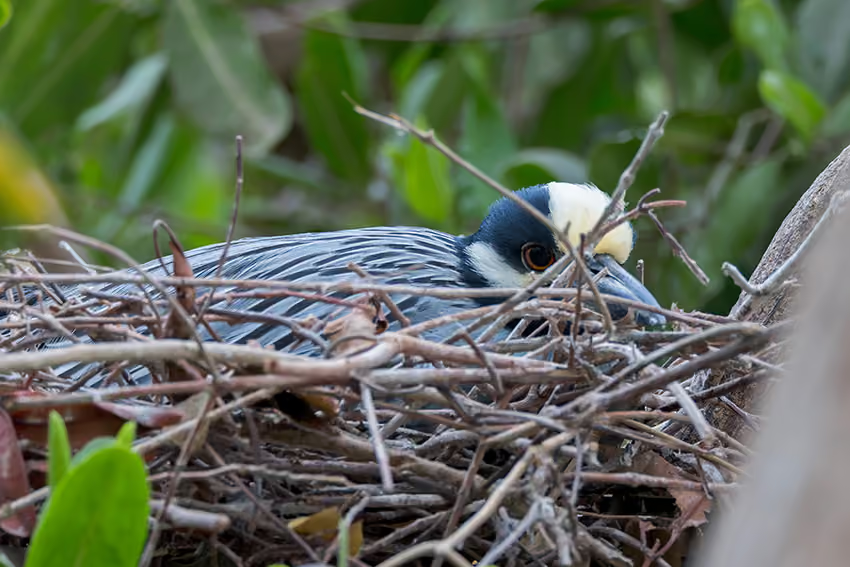
The Yellow-crowned Night Heron that arrives at the rookery in late May is not quite the bird you passed on the road in January.
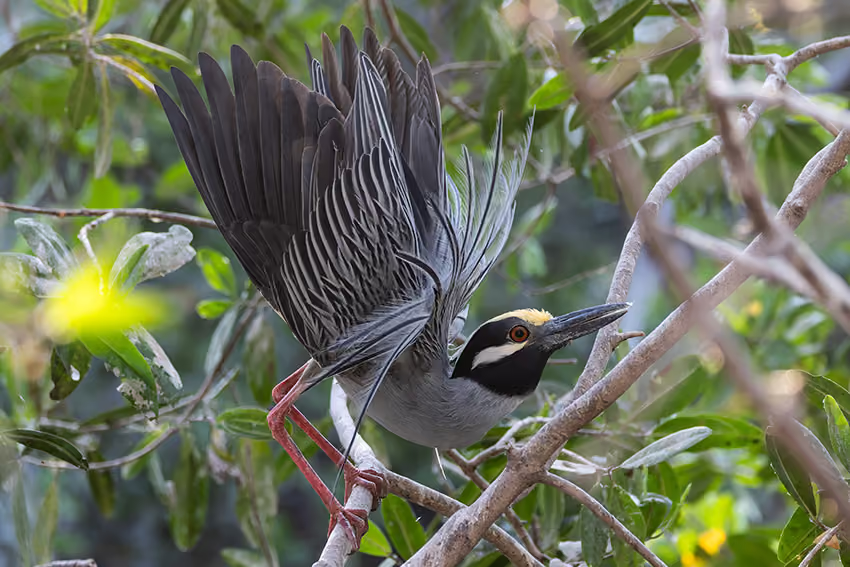
The transformation is gradual but dramatic. Long white plumes extend from the back of the head—elegant, impractical-looking, exactly the kind of ornamentation that evolution produces when the goal is impression rather than function. A lacy cape of delicate feathers drapes from the shoulders and falls down the back. And the crown—that almost-invisible suggestion of pale yellow that gives the species its name—deepens and brightens into a distinct golden blaze that finally justifies what you’ve been calling this bird all along.
I have watched this bird my entire adult life in Mexico. I have documented over a thousand species across this country and beyond. And the first time I watched a Yellow-crowned Night Heron in full breeding display—feathers fanned, cape spread, that golden crown raised, the whole bird rocking in a slow ritualized bob while producing a sound I can only describe as deeply unsettling—I was stopped cold.
It reminded me, not for the first time, that I need to pay attention to even the most familiar birds. They are all hiding something.
The display is directed both at potential mates and at rival males. The call that accompanies it is unlike the occasional flat “quock” you hear from the bird on your roof—it’s urgent, repetitive, strange. The nesting pair will typically raise two to three chicks, sometimes four. Both parents incubate and feed.
By July, the chicks are fledging. By August, they are dispersing.
This is when things get confusing for people who pay attention to birds but haven’t made the connection yet.
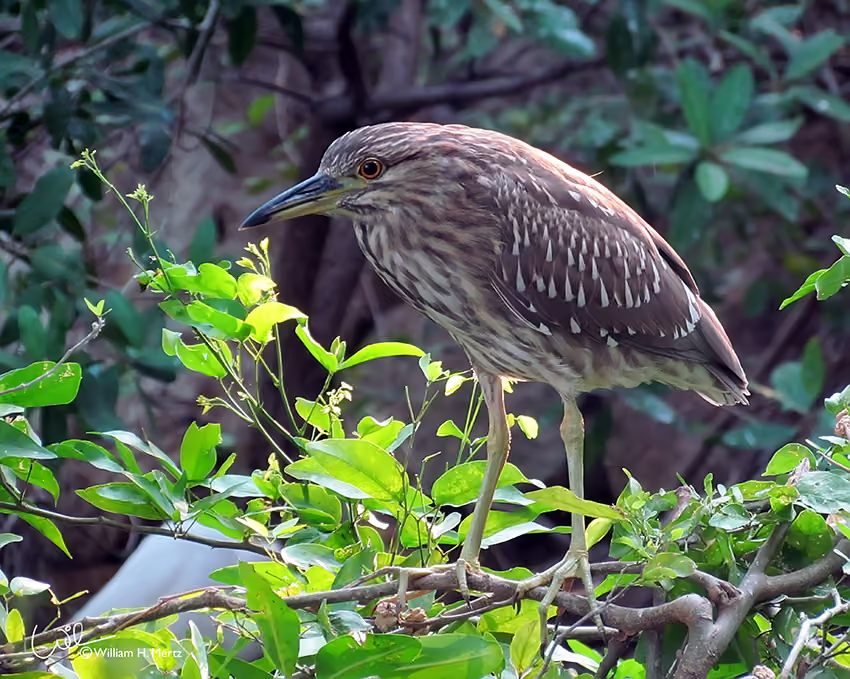
The juvenile Yellow-crowned Night Heron looks almost nothing like its parents. It is brown, heavily streaked and spotted with white—a completely different visual signature from the crisp gray-and-black adult. Young birds are also less cautious than adults, more visible, more likely to be found wandering beaches and roads in broad daylight. They show up in places adults avoid.
The result is that every year, around late summer and into fall, people see what they assume is a new and unfamiliar bird—brownish, streaked, heron-shaped—and cannot find it in any field guide because they are looking in the wrong section. They are looking for a different species. They are looking at a teenager.
It takes at least a year, sometimes longer, before the juvenile molts into adult plumage. In the meantime, it is learning the road, learning the crabs, learning the pools, learning Troncones.
Next time you see one standing motionless at the edge of a pool at midnight, or frozen on the beach road in your headlights, consider what you’re actually looking at. An animal with a 60-million-year lineage of heron ancestors behind it. A specialized hunter that has worked out, through some combination of instinct and learned behavior, exactly which crabs to take and how to disable them. A bird that spends half the year looking like a gray shadow and the other half dressed for a ceremony most of us will never witness.
It’s not asking for your attention. It never has.
That, I think, is exactly why it deserves it.
William H. Mertz is a naturalist, photographer and writer based in Troncones. He leads birding walks and publishes nature articles regularly in La Onda.