Bill Landrum: A Dancer’s Way
The award-winning choreographer reflects on his career, and why he loves Troncones so much
1974, Los Angeles. If you were in the world of performance, you would have heard of the already legendary dancers, Bill and Jacqui Landrum. Between them as performers, they’d done it all, from Beirut to Paris to Broadway. As teachers and directors of their own dance company, they held class regularly at The Coronet Theatre in West Hollywood, where floor space was at a premium. Having finally gathered my courage to attend, I found myself in their class one day. I’d been told they were sparklingly original if demanding teachers, who would ground you in dance as no other teachers could. What I’d not been told was that they were also two of the most beautiful people. Ever. To say that taking class with the Landrums was a life changing experience is not an exaggeration. Ask anyone who has studied under them. I was no exception. Because his Troncones home is called Casa Bailarin [house of the dancer], I thought that to start this interview by asking about dance, and Bill’s journey in it, seemed as good a place as any to begin.


.avif)





.avif)

%20(Spanish)-2.avif)




Linda: How were you initiated into the world of dance?
Bill: My mother was always dancing around the house. She taught me the dirty boogie. That was fun. My life as a dancer began with Jeannie Greer, a girlfriend in junior high school. She had performed as one of the snow children in the movie Carousel and so she was something of a celebrity in school. By proxy, I was too. After school one day, she invited me to go with her to the dance studio where she took class. The teacher asked me to join in what was a beginning jazz class. I fell in love with it. I couldn’t afford classes, but they offered that if I was willing to sweep the floors and clean the mirrors, I could take classes for free. That was the start, and out of that dance studio, we had many opportunities to perform at you name it…the Pomona Fair, the 4-H Club. We danced through kids in iron lungs in polio wards. I remember children following me in their wheel chairs. In 1955, I was hired to be an extra Mouseketeer for the opening ceremonies of Disneyland. Mara Lysova, a Russian dancer of note, saw me dance there and offered me a full scholarship for classical training. I studied under her for a couple of years and gained more experience performing in her little theatre. By the time I turned 18, I was choreographing cheerleaders, driving into Hollywood and meeting professional dancers. Through those contacts, I ended up auditioning for a job in San Francisco. I had to lie about my age. I said I was 23 and lived in fear that they’d find out. They never did. In another stroke of luck, my high school principal arranged for me to finish my courses by mail. I was doing three shows a night, seven nights a week. My father had always discouraged me from dance, but when he learned I was making almost twice the money he made a week, he said, “So there is money to be made as a dancer.” The subject of my life choice never came up again.
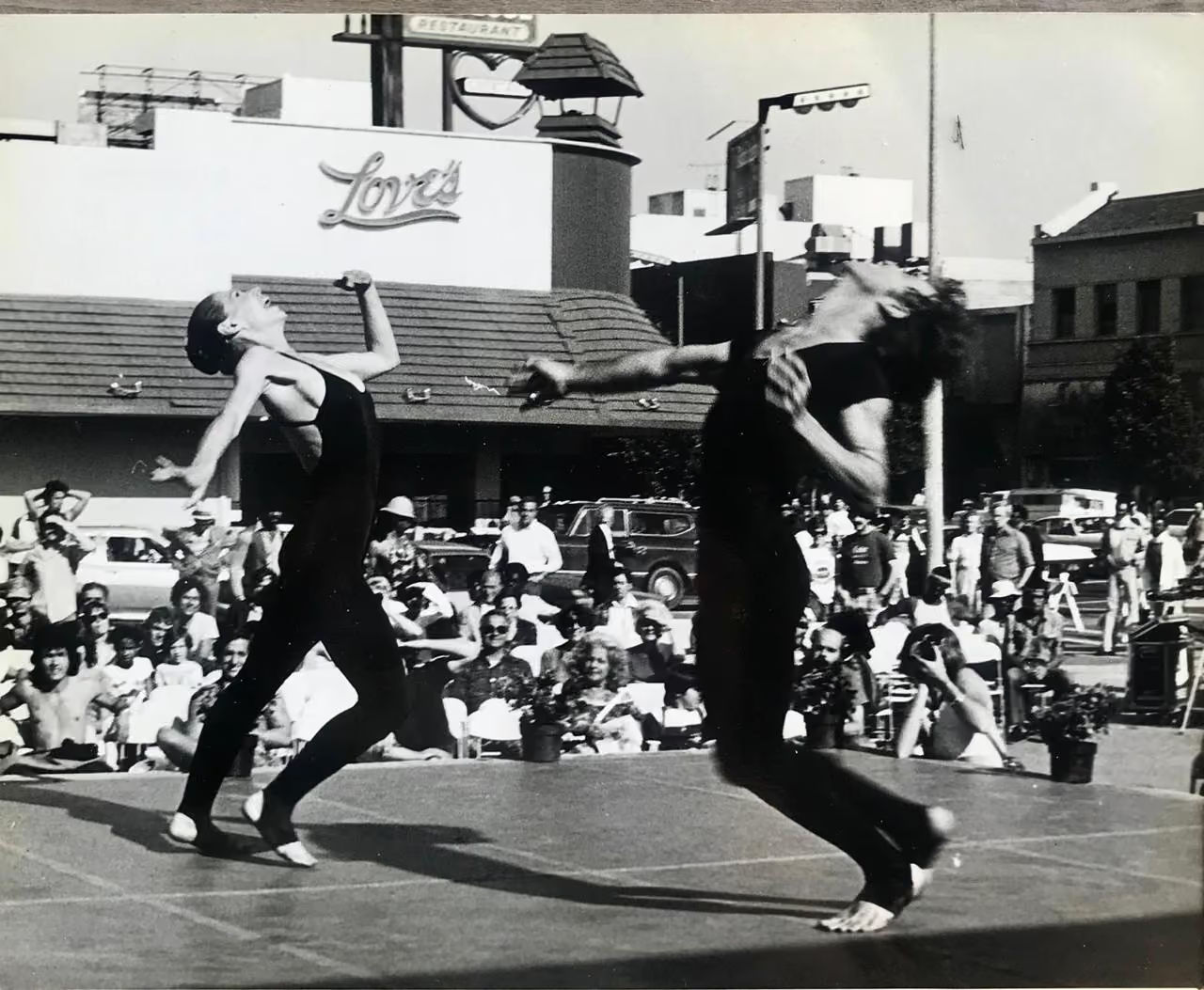
That job led to another one in Las Vegas which, in turn, led me to New York where I got to study…well…everything. I ended up doing All American on Broadway. Joshua Logan directed, Ray Bolger was the star and Mel Brooks wrote the script. It was fun, but I felt, somehow, it was not for me. I did not like being in the chorus, especially as I had grown accustomed by then to being the lead. Through friends, I was given an opportunity to audition for a show in Beirut and got it. That was three months of rehearsal in Paris, then two years in Beirut where I was a star. Traveling artists always came through Beirut in those days, so that became the gateway to an incredible exposure to the arts at large. For instance, I met Raymond Gerome, one of the stars of La Comédie-Française. We had an immediate connection and he became the greatest mentor I could ever have hoped for. I was basically uneducated and through him I strengthened my French and met incredible people. Franco Zefferelli, Ingrid Bergman, Salvador Dali to name just three luminaries. I was exposed to a world of intellectuals I never knew existed which deeply inspired me to grow as a human being. I left Beirut to take up a residency in Paris when the Casino that had hired me burned down. But that’s another story.
.avif)
Linda: How did you come upon Troncones?
Bill: My wife Jacqui and I used to take vacations from LA, where we lived and worked, to Zihuatanejo. Once Zihua started to grow, to our view, it lost some of its charm, so we began to explore other areas. Sedona and the like. About that time, Jacqui read an article in Travel & Leisure talking about the growth in Zihua and that if someone really wanted to get away from it all they should come to nearby Troncones and to “Call Dewey.” Jacqui called.
Jacqui: “Is it true that you have bougainvillea, great margaritas and a beautiful beach?”
Dewey: “I’m looking at it.”
.avif)
We booked a room for two weeks. The road from the highway down to the beach was dirt at the time. All clouds of dust, and bumps. You could only go a very few miles an hour. We kept wondering what on earth we’d done! Until, that is, we caught a view of the ocean. True to his word, Dewey greeted us with smiles and margaritas. He was comical, down to earth, more than generous…everything that we loved. Dewey’s one of the most wonderful human beings and has always been a good friend. I asked him once, referring to the ocean, how high the water comes up? He said “Where there is sand, there is ocean.” The realism of that aligns with his life philosophy. He’s the mayor of Troncones, basically. He got it all going and the paradise we experience here exists because of Dewey.
One day on that first visit, we overheard a couple from Chicago talking about the fact that they had bought property here and were making plans to build their dream house in paradise. Jacqui and I thought that would be fun to do one day, in our old age. Then we looked at each other and realized, “We are in our old age!” Well, we were in our 50s. That sounded old then. We bought our property in 1999. We fell in love with the work of [architect] Enrique Zozaya and jumped into having our house built. Because we were still working choreographers and dancers in Los Angeles, it was crucial for us to have a dance studio…a place to continue to create. The entire second floor of our house is just that, complete with a sprung floor…a first for Troncones.
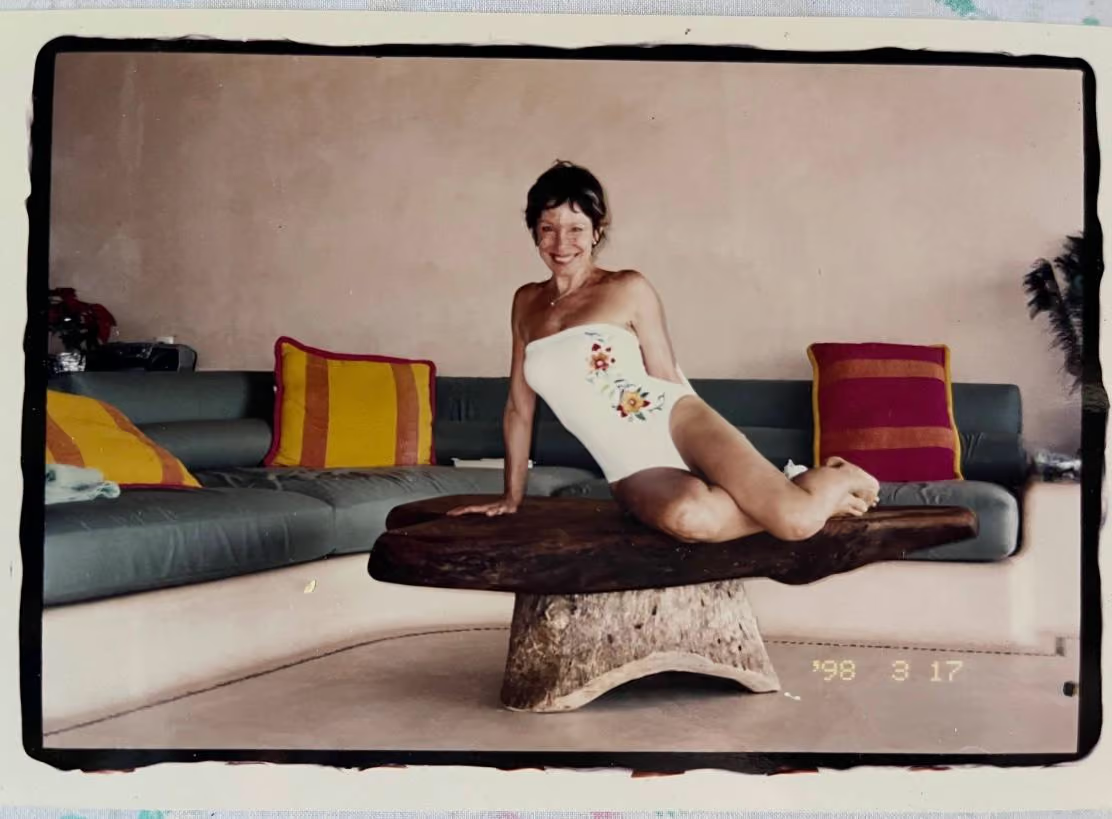
Having the studio meant we were never really separated from our dancing careers even when we were in Mexico. Over the decades now, it has proven to be such a blessing. It became a place to escape to, for artist friends to rehearse, even perform in. That continues to this day. The house has always been alive because of the studio and, over time, it has become a sacred space. Lupe and Damien have worked with me here at the house for the full 26 years. They have become family. Lupe manages everything to do with the house…which is not a small effort living in these elements. I couldn’t love her more. Damien has created an incredible garden that invites birds who perform water ballet in the pool, iguanas that climb my trees, lizards that run around and the occasional crab that walks through. It’s Eden.
Linda: How do you describe life in Troncones?
Bill: The experience of living in a village is incredible. Jacqui would say, “People only get together if someone yells, 'Help' or 'Party'!” People care here. The village operates on that level and that is not something I ever experienced in Los Angeles. People are always ready to help. I’ve had chicken soup delivered to me, cookies, fresh baked bread. Random acts of kindness.
Over the years now, it has been fun to watch the growth of Troncones. There are incredible varieties of restaurants and foods, services, working infrastructure. Even with the progress, it remains a place where you can stop the world. The outside only exists if you let it in.
I have to mention my friend of 26 years, the artist Meta…MariCarmen. Through her, I’ve met the most wonderful writers, directors, designers, architects. At her legendary lunches I have, so many times, felt like I was at a salon in Paris. A lot of my joy here is because of her.
Linda: Can you speak of the integration of foreigners here and specifically your philanthropic journey?
Bill: I’ve been involved in various community projects over the years. Las Hermanas, of course. That group does wonderful things. I was happy to help organize some fundraisers for an orphanage in La Unión. All along the way I have met wonderful people.
At some point, along with Pato, who’s another amazing human being, we thought it would be a great idea to create an organic gardening program at the school, a program designed for the kids to experience the full cycle, from planting to composting. Besides growing food for themselves, they came away with the knowledge of how to create an organic garden. Also, it became a bit of a compost-selling business. That program eventually dissipated, however, the idea of organic gardening did not. Pato gave a wonderful seminar series on organic gardening for property owners and gardeners alike. He also went on to create a whole art school. That came out of painting trash cans around Troncones, to draw attention to recycling and to just make things more attractive.
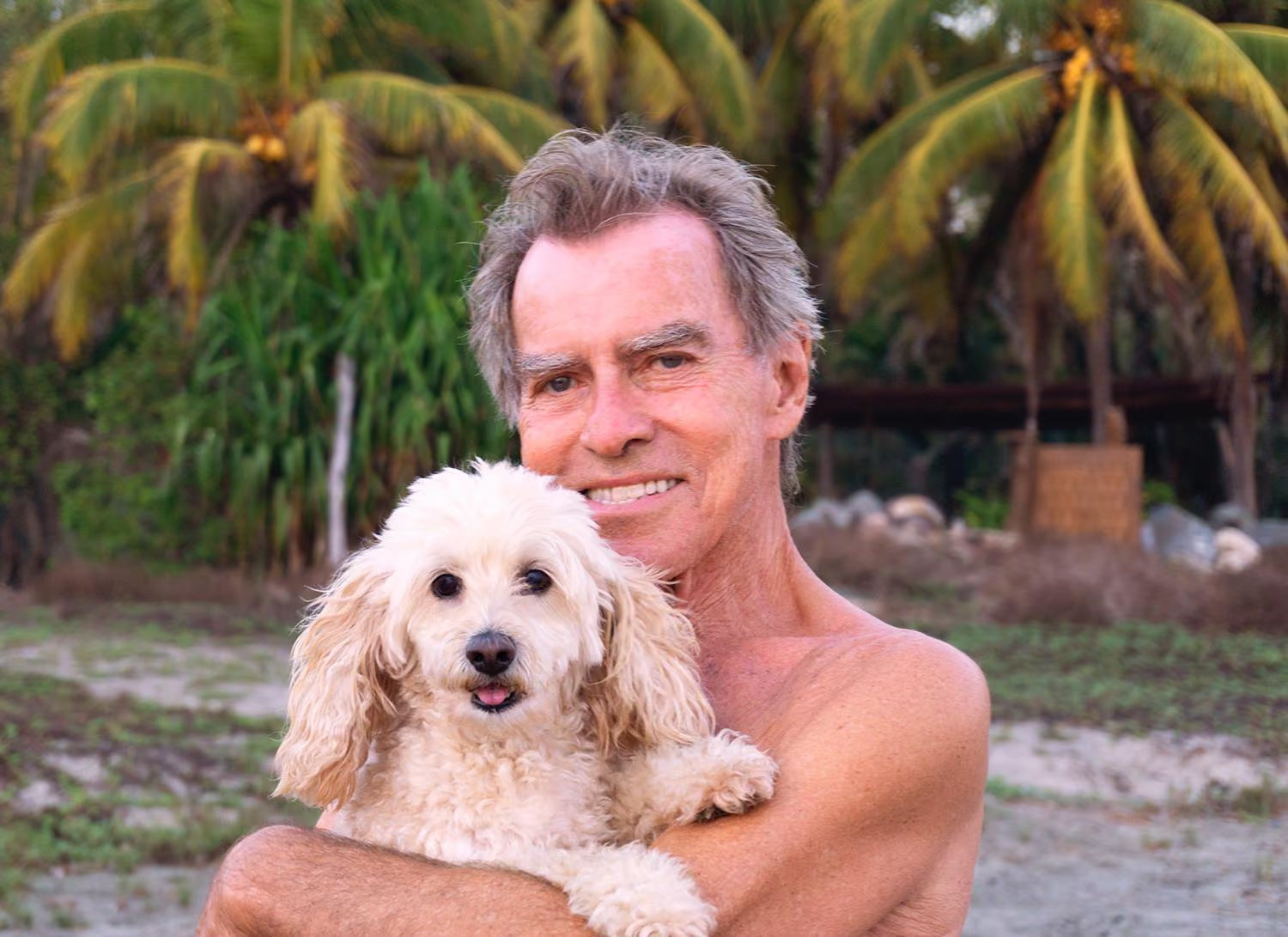
Now, I’m really into Surfers for Strays. I recently lost the only dog I’ve ever had. Mia. I so loved her. One of the things she taught me was a love for saving dogs and animals. When we first got to Troncones, sick and mangy strays were commonplace. It was heartbreaking. Through the efforts of Surfers for Strays, and various others, there has been, to my view, a real change in the culture toward animals. A newfound love, especially in the younger generation, for animals. You don’t see the tragedy of neglect nearly as often now. Dogs are loved and cared for here, and it’s just great to have a community that cares for their animals.
The thing is, speaking for myself, we’re gringos here. Having spent several years living in Europe in the Middle East, I was accustomed to adapting to living in other cultures. Not that I necessarily blended in but I did my best to learn the languages, respect the culture and find my place within them. When we moved to Troncones, one of the things we witnessed within our foreign community was a desire, in some cases, to impose their own cultural values. Over a period of years, a mutual understanding and level of communication has grown. Philanthropic efforts have continued to grow and, most importantly, continue to fine tune the balance of mutual respect, free of imposition.
Linda: What was your process of moving here?
Bill: My living here full-time only happened after Jacqui passed away. I was alone, no longer waking up and taking somebody else’s feelings into consideration. At the time she died, we were still teaching and choreographing, so the idea of living here full-time had never entered our minds. Once she passed, I continued to go back-and-forth, but every time I would arrive at my house in LA which I loved, I would miss my beach.
My whole life I’ve always been around hundreds of people on a set, on stage, in class or rehearsal hall. To make a move here as a full-time resident meant that everything stopped…my social contacts, my work. In truth, I always enjoyed working with dancers and performers…and, of course, the rehearsal process was great…but many times once we were into the actual filming, it was not pleasurable. Working with some directors was heaven; some stars, also, were great to work with. As happens in a collaborative work, you defer to the director and producer, so you do not, in the end, have autonomy. Often, we’d see the final product and feel that our work was not ultimately captured in the way we would have liked. Putting all this into perspective, I realized over the course of a few years that I was happier in Troncones. Mother Nature, its power, filled my spirit. That was the transition point. It really was about Mother Nature and the beauty and the beach and living near water. It gave me the space of accepting my letting go of the business. So, the adjustment to being here full time was not difficult at all. I can honestly say that I don’t miss what was.
Linda: Let me interject here a very abbreviated list of some of your cinematic choreography credits…an Emmy nomination; Moonlighting; Great Balls of Fire; China Beach; The Doors; Barton Fink; Basic Instinct; The Big Lebowski; O Brother, Where Art Thou?; Meat Loaf: To Hell and Back; The Singing Detective; An Affair to Remember.
You have always lived a life of beauty and movement and occurs to me that you are living in beauty and next to one of the most profound manifestations of movement the planet can give us, the pulse of the ocean. How does your journey as an artist continue and how is that influenced by Troncones?
Bill: It was movement that I chose for a career. Back in the day, I was called “beautiful”. A good thing, too, otherwise nobody would’ve hired me. Of course, I no longer have that, or the ability to dance, so that part of my life has been lived, but what I haven’t lost is the knowledge. I still feel that and have that on the inside. So, I’m now in a position to explore what I know and, instead of teaching it as I’ve done my whole life, I channel the knowledge through myself. All artists hope to find the authenticity of who they are and to find expression there. Troncones has given me a great place to be exploratory…it’s a great place to meditate, to hear my inner thoughts, to be quiet, be silent. The moment I start to move, the internal dialogue begins. Tells me to stretch or to swim. Tells me to do some kind of workout. Martha Graham, Feldenkrais, etc. As I explore working on my own body, I let the knowledge filter through. “Why am I doing this?” “How can I do this?” “How deep can I go and what does that signify?” The inner artist comes out and tells me whatever the assignment is for that particular day, and if I don’t listen to that my spirit gets stepped on.
.avif)
There’s a whole process. You go through memories and situations that bring up emotions or thoughts. I’ve been able, in the silence and beauty that nature gives me here, to get rid of anything vexing to my spirit. If something bothers me at this point, I throw it out. What is really interesting is that when you lose someone that you love, and then a dog that you love, the only question that keeps arising is “What is important?” I find that the only way you can continue living is to not give importance to anything. To take a neutral stance, reset in the breath. It’s very Zen.
What Troncones gives me is the continuing fulfillment of beauty and movement. In that process, I find the importance of discovering the inner universe. The inner universe within any of us. And that exists in direct relation to the ocean, to my garden, to the animals that come and visit. The web of the beauty around me guides me as to how I negotiate life. Troncones gives me that.