Wendy Worrell Page: Our Mermaid
Legendary surfer and activist recalls finding joy and connection in Troncones
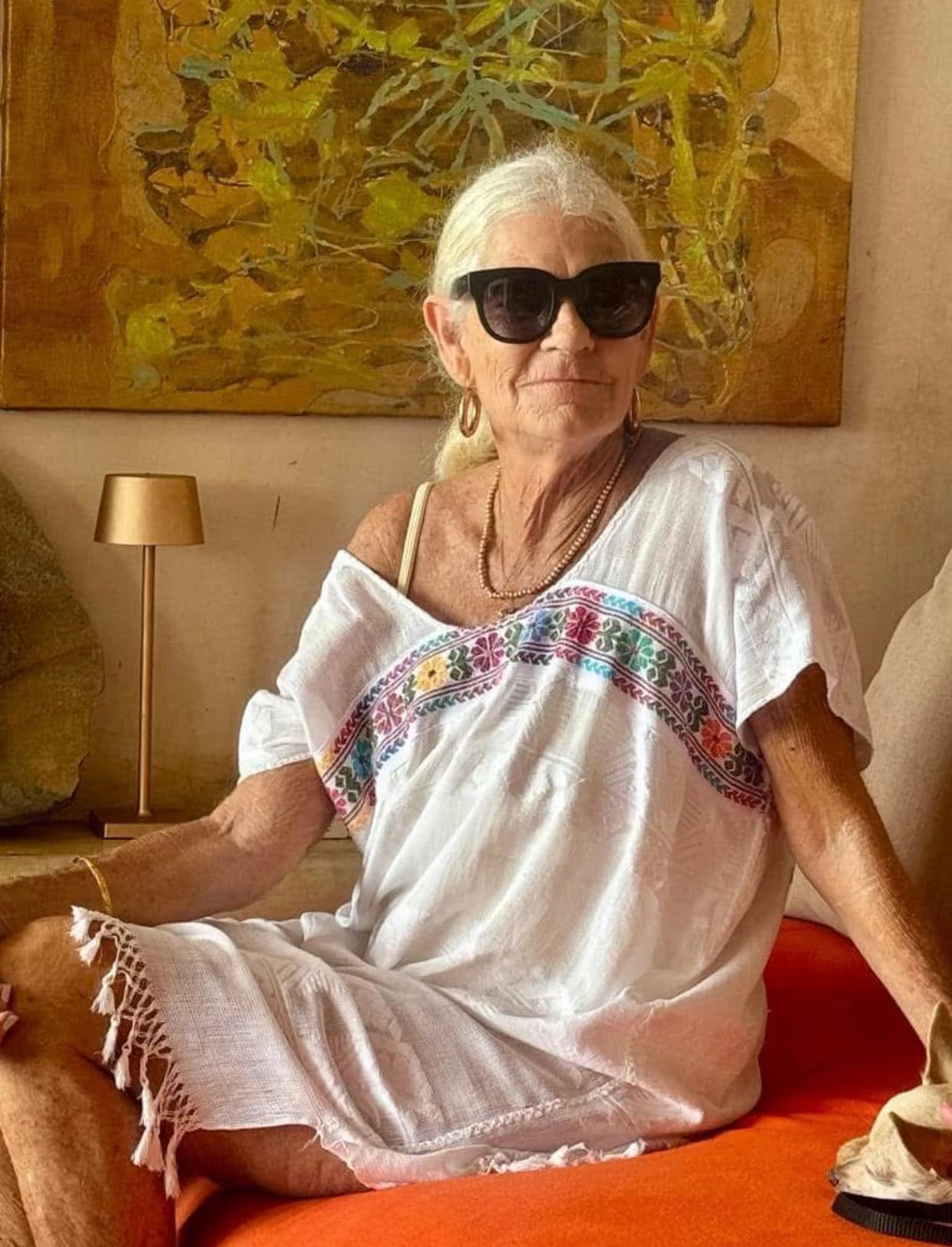
In getting ready to interview Wendy, I did a quick Google search of what the qualities of a mermaid might be. Here’s an edit of what I found: “Could be untameable. They manifest feminine power, demonstrate independence, have mystical wisdom. They’re drawn to beauty and they’re naturally graceful.” If I ever had doubts that Wendy was a mermaid, I don’t anymore. She chose Troncones four decades ago and it’s safe to say, Troncones chose her.

.avif)




.avif)
%20(Spanish)-2.avif)
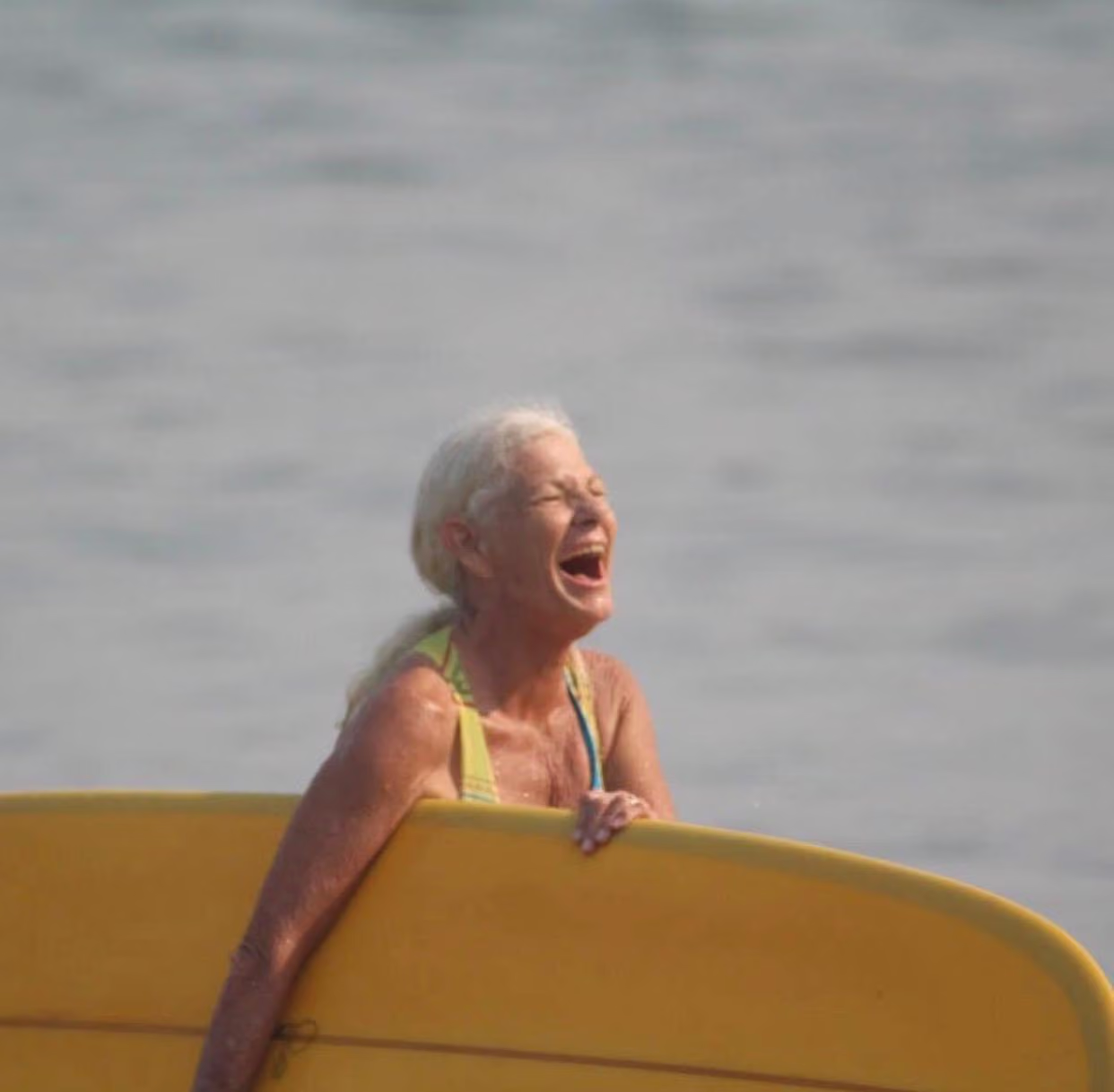
I know a mermaid and, if you live in Troncones, I bet you do, too. She hails originally from Texas and imbues a distinctly delicious no-BS, Lone Star grit. Truth and pathos are her currency. Having spent more than a healthy portion of her life in water, she’s amphibious, spry, lithe with the silhouette of a teenager, has enviable long wavey, flaxen hair and aquamarine eyes that sparkle diamonds on the water. Wendy Worrell Page. I met her years ago through our mutual and dear friend, Bill Landrum, who’s also a long-term Troncones local. Wendy and I sat down to visit the other day, appropriately, in her seaside home. Time suspended itself—I think that is one of her magical powers—and though she’s not in the habit of focusing on, much less speaking about herself, with some coaxing she shared some of her fascinating and adventurous life.
Wendy was born in San Antonio but moved to Bellaire, Texas which was closer to the water, when she was three. I’m guessing here, but maybe because Wendy’s dad was a sailor in the US Navy, who served in the South Pacific during WWII, she inherited a love of the sea. Wendy was a gifted swimmer as a child and took to surfing from the very first time she tried it. “We had a little black-and-white TV. Daddy had me watch The Wide World of Sports and said, ‘Here’s surfing. I want you to see what surfing looks like.’ I remember this vividly.” Her father never perceived a woman as being less capable or deserving. He encouraged broad horizons for his young daughter, giving her full reign to chase her dreams. Surfing? Go for it.
Linda: Tell me of your athletic career and how it led you to Mexico.
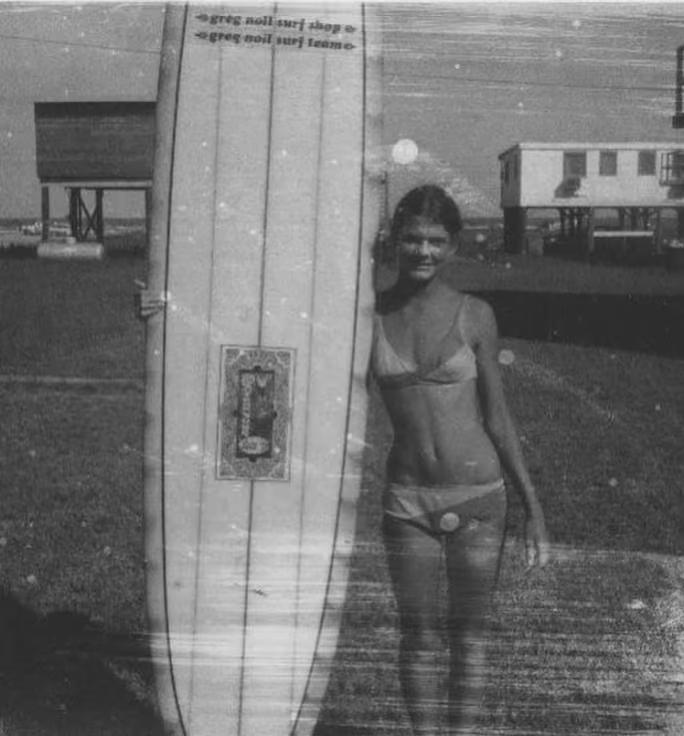
Wendy: I started surfing in earnest when I was 10. Mother and Daddy would fish in those same waters. And my sister and I happily took to surfing. The boards were so big then it took the two of us to carry the one. I got my first surfboard when I was 12, then my first custom board at 14 and I was active on teams from 15 on.
1975 was a pivotal year for me. I was 21, and living on the Mexican border on San Padre Island. I’d set my sights on getting to Petacalco, a famous big wave place that Texans, among others, were drawn to. Together with a couple and their year-old son, and my close friend Pam, we set out in a beat up 1965 Rambler sedan. All of us, besides the baby, were surfers. Our 1200-mile route, pre-toll roads, took us out of the flat Texas coast into arid brushland, through an ascent of the Sierra Madres and their volcanic highlands and, then, finally to a dramatic descent to the Pacific. Even between us, we had no money. We had our boards, tents but no poles and a Rambler that was prone to breaking down. Pam, a real Texas cowgirl, brought along a horse halter. As far as we were concerned, we were fully-equipped. Later on, Pam would find the occasional horse on a beach. She’d get her halter on him, and off they’d go. It was something to see.
More than once, we’d get to the top of a mountain only for the car to die. We’d get it turned around then coast down backwards in neutral. Our backroad route—which was the only route—took us through many small villages, more often than not with indigenous, non-Spanish-speaking, inhabitants. Even small stores for supplies were a rarity, but we had that one-year-old, blonde, blue-eyed baby boy. He was our ticket. That baby opened all the doors. More than once, good Samaritans would take us into their home, overnight, if need be, fix the car and send us on our way.”
[Listening to her story, I suspect this was when Wendy started to fall in love with Mexico. How could you not?]
Through luck, and the grace of strangers, we finally made it to Petacalco where the surf breaks didn’t disappoint. We ventured on to Rio Nexpa in Michoacan. That’s where I felt my first earthquake. We also did side trips, to a pristine Manzanillo Bay and to Playa Saladita. There were surfers in Rio Nexpa from all over the world. At nights, this impromptu global community of kindred spirits would hang out at the campfire. I remember one memorable fellow—if you can imagine—a Frenchman in silk pajamas. I took to making myself a bed, down close to the beach only to discover a lot of sea turtle eggs. Heartbreaking at that time, to see them being taken away by the hundreds. That was hard. Understand, things were very different then and turtles were on most restaurant menus at the time. Maybe that heartache is how I first became interested in conservation. So many things have changed for the better these many years later. Care for turtles is just one of them.
Linda: Tell me about the experience of surfing itself.
Wendy: Even though I was on a surf team growing up, surfing was always a solitary sport for me. I was very much a loner and a scrapper—I didn’t like talking to anybody out in the water, I didn’t really like hanging at the beach—which is not to say that there have not been many wonderful people and friendships through the years. Surfing cultivated a kind of natural competitive nature in me. I developed ways and tricks—you had to, especially in the early days. Maybe that’s why the Mexicans gave me the name “La Tiburona Blanca”, The White Shark.
Once you catch a wave and ride it, you’re hooked. I liken it to dancing, dancing by instinct. I learned from a surfing documentary that some of the first people tested to be astronauts were surfers. I suspect there are correlations—the feeling of movement through space when you ride off the top of the wave, where your board disconnects, and then you’re in free fall. As you progress through surfing, your experience broadens from that first feeling of the speed, to knowing how to manipulate that speed, to learning where the source of the power comes from. You learn how the wave breaks, and the maneuvers that keep you in the power spot, the movements on your board that makes you go faster or slow down.
I’ve always been a warm water person. That’s why I couldn’t live in California. And like all of us in the sport, I’ve been able to travel to several countries and surf different beaches in each one—most notably Costa Rica—and, of course, throughout the US—in Puerto Rico, Texas and Hawaii, extensively. You experience so many variables of surf condition—beach break, point break, reef break, weather, etc.
[As a non-surfer, listening to this sounds like surfing teaches, if nothing else, a form of adaptability. It’s not lost on me that as Wendy speaks, her spine moves like licorice, as if in, well, water. She also erupts into spontaneous, utterly infectious laughter.]

Linda: How has the culture of surfing changed?
Wendy: Over the decades that I was actively surfing, there was always something changing. There was a lot of intimidation in the era I was brought up in. It was before lawsuits. You’d paddle out for the break, people would get beat up, you’d be pushed off your board. I got pushed off my board all the time when I was young. It was a pretty wild sport. I think some people have an impression that it was like the Gidget movies—Beach Blanket Bingo—and Beach Boys music. It wasn’t. Also, women were rare out there and not overly welcome. I bought surf magazines for 20 years before women were properly photographed in them. In 2018, women finally gained financial parity with men. In terms of the boards themselves, 1967 was a big revolution, boards started getting smaller. The materials changed, and the sophistication of the hydrodynamics did, too. As the sport grew, it got better.
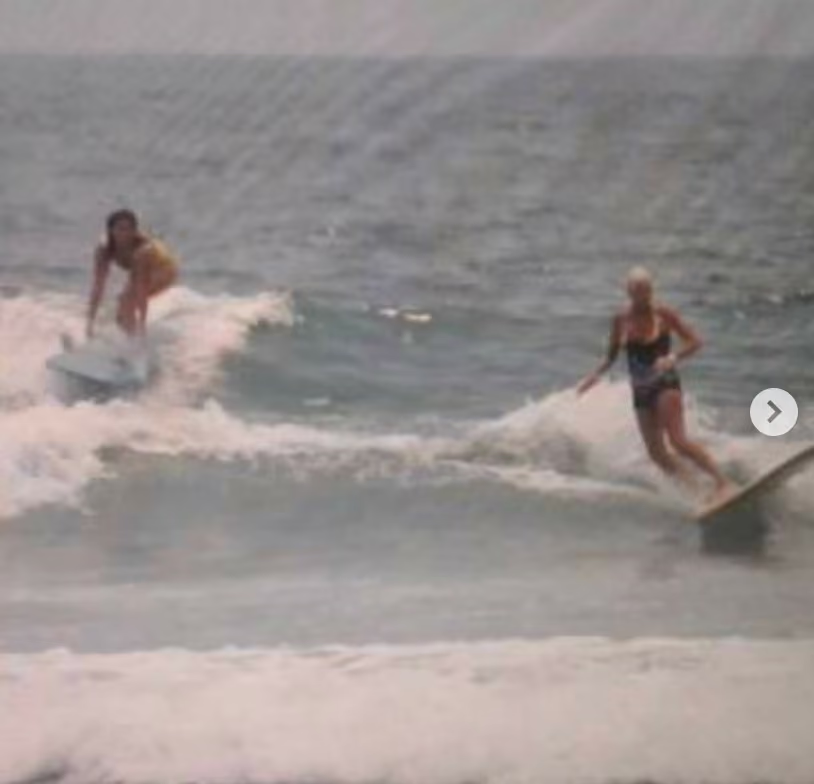
Linda: What sort of treasures and life lessons has surfing given you?
Wendy: Some of those most beautiful natural moments I've ever experienced have been while sitting on my board. One day, for instance, there was a massive school of baby marlin that came leaping into the air in patterns of movement as they travelled past me. I was watching in wonder at their neon colors flashing in the sunlight, when one of them flipped into the well of water between my legs. There he was, about two inches long, with a tiny, perfectly formed bill. Its front fins were tiny buds on either side. Its little brethren were almost all past me so I just sank, slid off my board, the little guy slid off, too, and proceeded right in the direction of the baby marlin school. That’s the power of nature!
Many times, at Playa Saladita, over the winter, when the waves are small, you can ride all the way in. Looking down through those clear waters, you can see that the rocks are alive with coral, fish and turtles. It is truly awe-inspiring, very joyful.
[Sounds better than a world-class museum to me.]
I had a dear friend, a terrific surfer, years ago who was continuing through a cancer battle. She had the most wonderful attitude of any human I’ve ever known. One day, we were out there, in big waves. I’d had a pretty significant hold down a couple of months earlier. After almost drowning, the waves that day were bigger than I was comfortable with. I lost my board on the paddle out and was just going to go in, but my friend had my board for me. With all she was going through, fighting for her life, she was going to keep on paddling out. Both embarrassed and inspired, I did, too. I’ve been fortunate to know many wonderful people through the sport who have gifted me turning-point moments like that.
Linda: How do you describe the why and now of Troncones?
Wendy: There was never any doubt I wanted to move to Mexico. I always liked this area in particular—its amazing climate, its natural beauty—the mountains in the back, the palm trees, the green right down to the beaches, the nearby surf spots. That was all perfect for me. Fortunately, my husband agreed. Kim is a marine biologist/shrimp farmer whose career continues to take him around the world. He’s also a surfer, and he’s quite happy to call Troncones “home”, which it has been for us pretty much for 20 years now.
What we love most though are the people here. We have always felt included and appreciated. Some of my fondest memories are connected to community events in the early years. The Mother’s Day celebration at the elementary school. Who can forget that? The kermes events and dances; the weddings, the quinceañeras and the graduations.
Linda: What are some of the ways you’ve connected to the community here?
Wendy: In about 2011, a few of us realized there were no male dogs listed in the spay clinic. We in turn asked a girlfriend in town if she knew why there weren’t any male dogs listed? She explained, haltingly, “There is, there is, [now here, you can hear the Texas in Wendy come on as she finishes the thought] the snip to the balls.”
We decided to attend a meeting of the minds in town to present our support in favor of getting male dogs on the list, and we backed that up with a pledge of a healthy supply of dog food to the clinic. So we went, and I arrived on my new bicycle. We waited for our moment, listening from the outside under a tree. I heard somebody say, “Tell the gringa we want to ride her bike.” I say, “You can ride my bike all day if you’ll get me some male dogs to be sterilized.” They all laughed. Pressing it further, with everyone still laughing, I made a joke, along the lines of “You’d think the men were afraid we were going to cut their balls off instead of the dogs.” I got 30 male dogs listed the next day. Who’d have thought a bike, a joke and some bags of dog food would instantaneously solve a problem? Getting to feel a part of this community is a joy.
My primary focus now is Las Hermanas. We started over a decade ago with just the five of us, Anne, Mallory, Lolo, Jill and I. We were at the old Chencho’s, probably over a couple of bottles of wine, and we put in $100 each. It is remarkable to see the ways in which Las Hermanas continues to grow. [Las Hermanas began with a simple goal: to ensure every local child, regardless of family resources, has the chance to pursue an education and build a brighter future. The initial effort to provide school transportation and supplies has grown into a grassroots program supporting students from preschool through university.]
Linda: What’s new for you in Troncones?
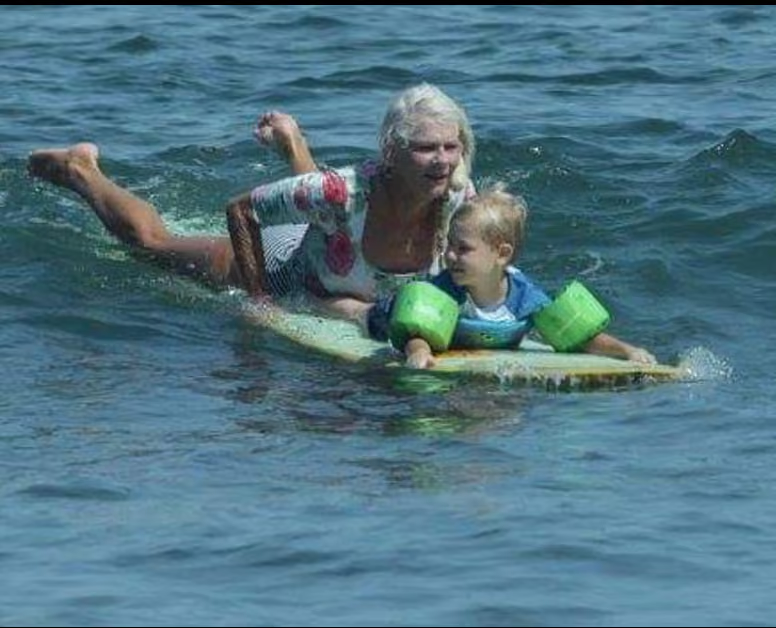
Wendy: Right now, I’m looking forward to the future, and to getting to share “The Troncones Life” with my daughter and grandson, who are moving here this summer. My surfing days are behind me. I still watch every surf contest and I keep after my friends on Instagram when they surf. I marvel at the wave of talented young girls coming in. That’s really interesting. It’s all still part of me. I just don’t paddle out.

LINKS