Boogie Boarding Ain’t for Weenies
A reflection on surfing, with a little help from a friend
I met a guy who I wanted to interview for La Onda Troncones. Decades ago, he and some avant-garde theater friends took simple Sony Walkman technology and transformed it into a new method for museum goers to learn about the art they’re seeing. There was no “playing small” with their idea. They revolutionized the visitor experience at some of the most famous museums around the world. At 75 years old, he’s now living part-time in Troncones planning and preparing for what he wants to do next. There’s no way he’s retiring. He wouldn’t know how. But my new friend didn’t want to talk about himself. He didn’t want to do an interview. As we got to talking about surfing and boogie boarding, he kept describing them in terms I hadn’t heard before. I got it—I’ll get him to go boogie boarding with me, and I’ll write about it. I wasn’t ready for what happened next.
%2017.27.38.avif)
.avif)




.avif)
%20(Spanish)-2.avif)
I didn’t grow up near an ocean. I didn’t see one until I was a teenager, but somehow when I did, it made sense to me. The rhythm, the swells, the current, the light and the lifestyle—the being in sync with the water, the weather and the wind. I’ll make a long story short: I moved to Troncones at 60 years old, looking forward to surfing daily. That said, I’d never learned to get up on a surfboard, but bodysurfing and catching waves using kayaks, inflatable rafts and boogie boards came somewhat naturally to me.
After I was here a bit, I found a place to go to, an uncrowded spot, an outer beach break, offering somewhat erratic but intensely fun waves. It had some great “drops”, that motion of sliding down the wave, which sometimes feels like falling or flying, where your timing, commitment and direction determine your ride. Three years later, my kayak couldn’t take it anymore. It already had some cracks when it got here and this new spot kept making those cracks bigger and blew apart every patch I made. I was taking on too much water to be safe, especially when other people came around.
I was left with no choice—I had to learn how to surf in a new way. I bought and tried a soft-top surfboard. I watched videos. I took the board out into the break. The experience was unsatisfying, even if I knew falling, tumbling, perling and being a kook would be part of the process. I started riding my boogie board more instead. I felt a little defeated. I wasn’t able to do what the other kids were doing. But I really liked this new experience of the water, even if I felt somewhat wimpy, like I’d surrendered before I had to.
RACE CAR FAST
It turns out Troncones is “home” to two Mexican national champion boogie boarders—Juan Suazo Perez and Arturo Ayala Maciel (both have surf shops near the bridge). Arturo brought a Mexican Surf Federation-sanctioned event to Troncones this past March. It was good to see that professional level of talent and performance here. It didn’t look wimpy at all.
Then I made a new friend, who described himself as being “board agnostic”, that he’d started out bodysurfing, “upgraded” to boogie boarding, and then “toyed “with board surfing off and on, and that he liked to handplane [a flat device used for bodysurfing]. Board agnostic. I liked that. Anything that floats and goes is good.
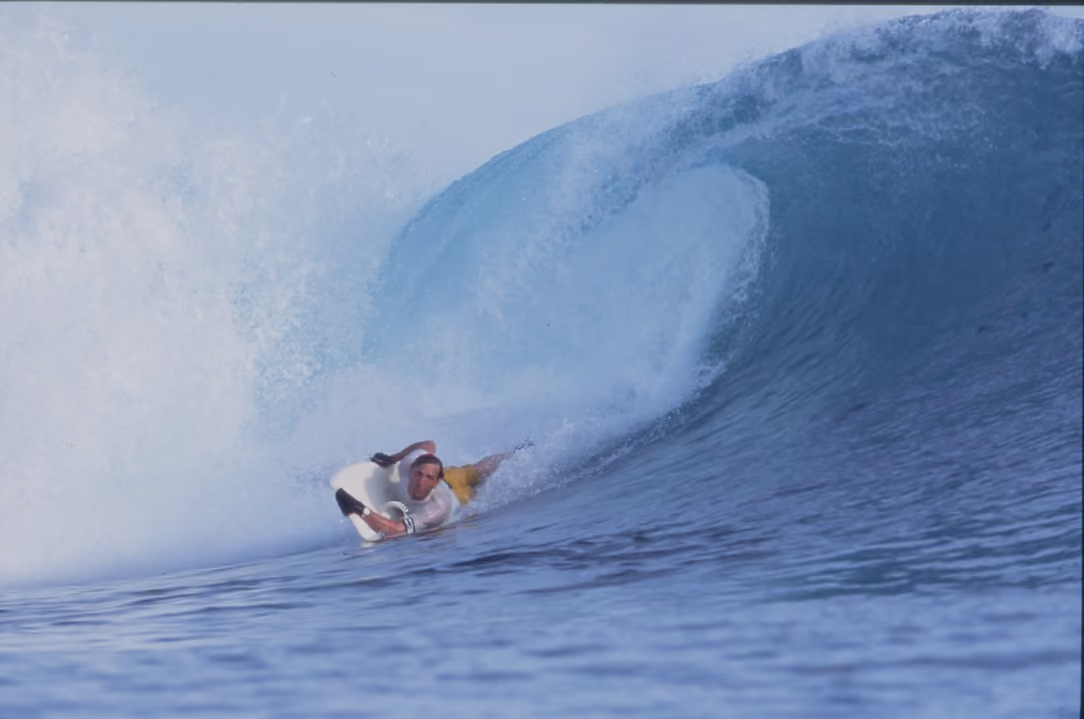
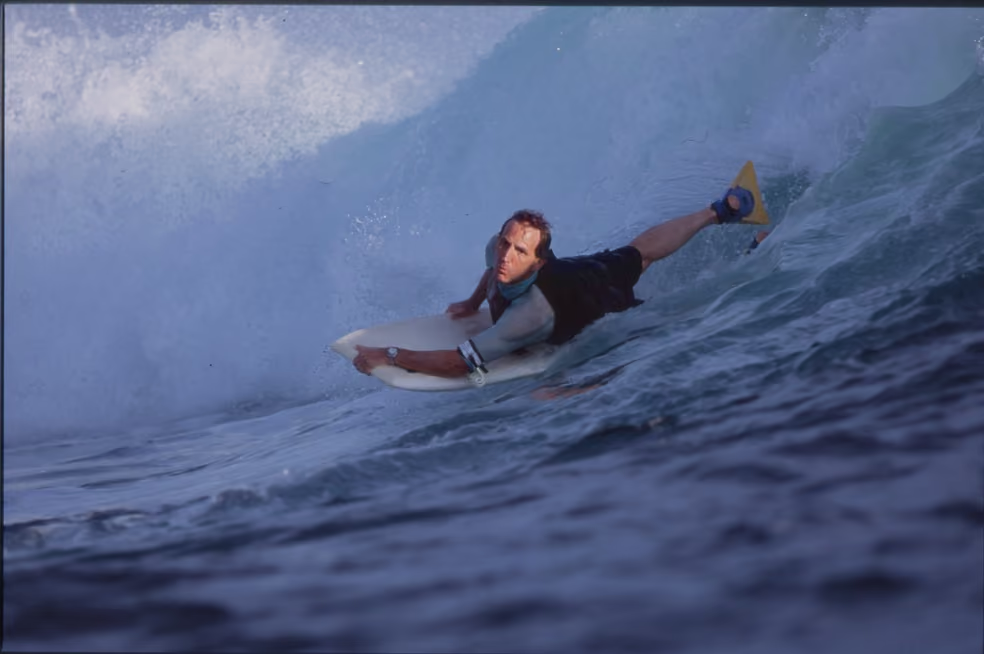
He went on to say that surfing was different, that it was the only sport “where the field comes to you”, where the player has to adjust to conditions that are constantly changing. Imagine the soccer pitch moving, an undulating football field. He said he got more serious about board surfing when he turned 55 and his company gave him a longboard at his retirement. He thought he got decent at longboarding but went back to boogie boarding because he was better at it, caught more waves and didn’t have to wrestle with a heavy board. What struck me is when he added, “I like going headfirst and being close to the water. It’s like driving a race car.”
Zoom. That’s it. That’s what I like. That’s the feeling that makes kids say, “whee” when they first catch a wave on a boogie board. Exhilaration. Acceleration. In big waves, it’s a sudden and immediate force, pure speed. It’s that same feeling I had when I caught my first hurricane wave on a kayak, the thrill of riding a powerful pulse that’s rising through the water, like something untamed sent from another dimension. Not whee. “Whoa”. I had to remember to breathe.
A PLAYDATE
It’s a little strange wanting to ask someone you just met to go surfing. Not all surfers are wired the same way. And you never want to go out with someone you need to take care of, especially if you’re out for size or going to a place that can be treacherous. My spot is a beach break, prone to rips, currents and close outs. My new friend likes a point break in Troncones, a spot known for sea urchins, jellyfish, sharks and mushy shoulders. One of us would have to adjust for the other.
It turned out he was leaving for his other home in a few days and we wouldn’t be able to go out on this visit. While he was away, we traded emails about surfing, and in conversation I read: “Surfing is as much a virus as it is a sport. If you are a surfer and the waves are good, and you’re not out, it can be very disturbing.” I know the feeling.
Later, he wrote: “As for surfing itself, it is free and unpredictable. Catching waves is like judging fly balls. You greatly benefit from experience. You sit there and wait, and when a bulge appears on the horizon, your processing power kicks in as you analyze speed, height, and position to try to get into the right place. Even the best surfers miss waves. Every wave is different. Every session is unique and, in some places, like Hanalei Bay, you can surf every day of your life, and it will never be the same. That serendipity is part of the appeal.”
And, finally, my favorite: “Catching waves is free, clean and natural. Every wave is a gift. Surfing every day is the fountain of youth.” Oh, yeah. Here’s a guy who’s 75, who goes in at Ocean Beach in San Francisco on his birthday every year because he wants to make sure he still can. That’s not a spot for weenies. It’s a heavy wave. I started to wonder if I’d be able to keep up.
My friend was back in town just as Genevieve was moving from being a tropical storm to being a hurricane. I wrote to him about going out before it got “too big”. He wrote back saying he’d pick me up at 8. But he didn’t say where we were going. I put fins, board, surf shirt and a towel all in one place. I felt like a kid.
THE SESSION
When he appeared in my kitchen, he had Band-Aids strategically placed on his feet. My fins tend to rub me raw after a while, and I’ve tried socks, booties and other solutions. Band-Aids. Cover up before the pain. Good idea. Most times, I don’t use fins. I stay on the “inside”, where I can touch the bottom still, and I find faces to surf in the white water. I told my friend I’d been getting 75-yard rides at my spot. He told me he got a 375-yard ride at his. Fins help make that possible. You can go out further, past the breaking waves, past the white water, out to where the real waves are—and you ride along the length of the wave as it breaks.
He drove to my spot, the beach break. That spared me in having to figure out the rocks and creatures at his point break. And he knew he wouldn’t have to save me. That I knew the currents. We got our fins on and went out into the water.
When we pulled up in his car the ocean looked flat, but that’s the joy of a “ground swell”, the waves produced by far-off storms. It’s flat one minute and the next you’re paddling toward the horizon, out of instinct, every cell in your body knowing before you do that a set of waves is racing towards you—and you want to be “outside”, not inside where they’re going to break. On our way paddling out, a wave broke far out, trucking through as a wall of white water. I was already well off the sandy bottom. It was a wave I’d only be able to take with fins. So, I took it, and I had so much fun that I took it all the way in to the beach. My friend duck dived under that wave and was soon out in the open ocean. I was back on shore.
Soon enough, I got through the inside waves and got outside where he was, but the currents there kept us apart. That was okay—we could learn how we each moved. He took off on a wave, dropped down and went out of my sight, coming back out before he ended up in the white water. Me, I took something smaller, got tumbled and came back up, glad to get the first wipeout over with. Then, I took another wave, a small rise, with a small face, with a load of heavy water behind it. It picked me up and let me fall just as another peak formed alongside me. I got that one, too, and before I knew it, I was racing along, zooming on top of the water, heading inside, not a care in the world. I kept going with it and found myself on the beach again. My friend was outside in the open water, getting another wave.
I headed back out but I never got there. Each time I got off the sand bar, I got caught in the impact zone, wave after wave break in front of me, not letting me through. I never found that one seam I needed to get through the churning. But I realized I’d found a current, one I knew, one that runs diagonal to the beach. That eventually put me in front of a big wall of white water which brought me all the way in again. There I was on the beach again. This time I was a couple hundred yards south from where I’d put in. I took my fins off and walked back. My friend was still outside, still dropping in on waves.
AFTERWARDS
I went back out. I found my friend again. Not the one on the board, but the one that runs diagonal to the beach. I repeated the cycle—paddling, diving, churning, paddling, diving, churning—measuring my distance between where I was to where I know there are sharp volcanic rocks. My arms were gassed and I wasn’t getting outside, so I waited again, got myself a big wall of white water and took it all the way into the beach. There was little satisfaction in that moment in knowing I’d gotten a 100-yard ride. By then, my fins had rubbed me raw. I took the long walk back again, ditched the fins and went to play like I usually do, finding faces in the white water, getting long rides that were mostly straight in, me switching left and then right and then back again, depending on where I found a peak.
And then my friend came in. We’d said an hour. It had been about an hour and a half. He seemed content, saying, “I got some. That felt good.” That’s surfing. I jumped on that, saying, “Me, too. I got some, and it felt good.” I told him about finding the current and surrendering to what I could do. He offered me his fins which he thought would make a difference for me. That’s surfing, too. I passed. I’d had enough “fun” for one hour.
On the drive home, my friend talked about how he went out cautious, not sure of the beach break, of being in a new spot, how he liked that—being a little scared—and how it made him appreciate his point break where he doesn’t have to work so hard, where he sometimes makes it out without even getting his hair wet. He also talked about how he only used to come to Troncones in the summer, because that’s when the waves get to eight feet and “they have consequences”. He said he started coming in the winter, too, when the ocean was less intense, to what he called “AARP waves”, but then he realized those were good, too, that “Troncones was a sort of paradise that way—easy waves, hard waves, no wet suits, always warm, always surf.” And then, he was off. I heard he was at his point break for some of the bigger waves of Genevieve.
A-HA
Me, I went back to my spot. No fins. It took a week for the currents to calm down there, where every session wasn’t an adventure in timing, drifting, lining up, calculating and tumbling—zooming sometimes. I went every day. Not chasing the fountain of youth, but because it’s where I find peace of mind, it’s where I can drop pretense, details, preferences and everything else. It’s where I find a sense of appreciation, intuitive communion—where I find out how I’m actually “doing” in how I react and respond to the waves. I’ve known and felt all that before, but I never quite the way I did after my session with my new friend. It was like listening with a new ear or hearing with my heart. I have a surf friend in Montauk who says, “Whoever has the most fun wins”. I’m thinking now, “How you surf is how you do everything.” That’s a new idea for me.
And about my new friend. His company’s client list included the Louvre in Paris, the Vatican in Rome, the National Gallery of Art in London, Terra Cotta Warrior Museum in Xian, China, the J. Paul Getty Museum in Los Angeles, and the Metropolitan Museum in New York. Even Graceland in Memphis, Tennessee and Alcatraz in San Francisco Bay. Now he’s living in Troncones. It’ll be interesting to see what he does here. How you surf is how you do everything.
One last text: I sent this to my friend to make sure he was good with all this. He wrote back, saying: “In many lineups, boogie boarding is low on the pecking order and much maligned. Body boarders are variously referred to as ‘spongers, boogies or speed bumps’. [They’re called ‘dick draggers’ in Puerto Rico.] But this is a denial of the core thrill. Remember when you first made your way up to the high board at the local pool and peered over the edge? Bodyboarding is the difference between jumping off that board or diving headfirst.
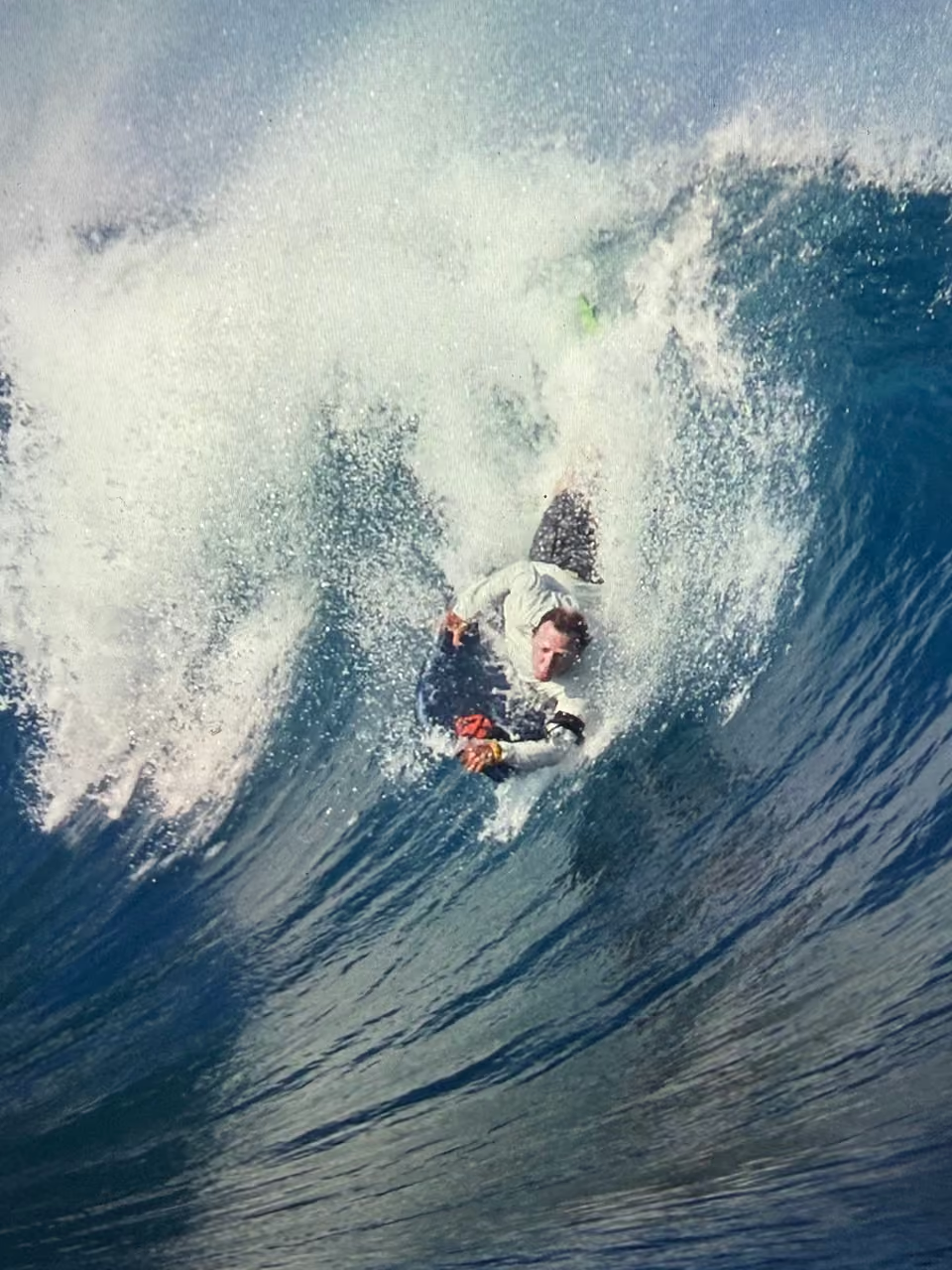
There is a moment on a big wave where it lifts you up from behind like an elevator and you are poised on the lip looking way down to a flat surface that seems impossibly distant. Then you dig like mad to make it over the edge. There is total adrenaline-fueled roller-coaster weightlessness as you skim headfirst straight down, barely touching the wave, eyes a few inches from the ocean’s surface.
When you reach the bottom, you arch your whole body as you carve a wide turn to get back up to the top of the wave, sending out a plume of water. Repeat.
In some individual sports there is a whole-body rush that comes from carving a long turn in powder snow, or coming off the bottom on a big wave. On a boogie board or body surfing, your whole body melds into the wave and you adjust and flow with forces of nature that you just do not experience in other playing fields. What always amazes me is the small amount of board that makes contact on a wave. Sometimes it feels like you are flying across the surface on a potato chip.”
.avif)