The Chief of the Parota
Meet the Yellow-winged Cacique—our local master weaver
Over the past year or so I’ve written close to a dozen bird pieces for this magazine. Not long ago, I went back through the list and noticed a hole in it big enough to hang a meter-long nest from. I have never written about the Yellow-winged Cacique. That’s a strange omission. It’s one of the most common birds in Troncones, one of the loudest, and certainly one of the most recognizable: black and yellow, impossible to ignore. Its nests are the single thing people ask me about more than anything else with feathers. Writing a run of local bird pieces without mentioning it is a bit like writing about Troncones and forgetting to mention the ocean. So, belatedly, here it is — the Yellow-winged Cacique
















FIRST, HOW TO SAY IT
The word cacique came into Spanish from the Taíno of the Caribbean, where it meant chief. It still means that in Mexico, usually about a local political boss, and rarely as a compliment. In Spanish it’s three syllables: ka-SEE-keh. Most English-speaking birders clip it to two, ka-SEEK, and let the ending fall off. Neither is wrong in its own language. But you’re in Mexico, and the bird is very much Mexican, so ka-SEE-keh is the one I’d use.
Its other English name, Mexican Cacique, is the more honest one. The species lives almost nowhere else: the Pacific slope from southern Sonora down to Chiapas, with a small foothold across the border in Guatemala. People fly a long way to see a bird that sits on your neighbor’s palm every morning.
Locally, though, almost nobody calls it a cacique. Here it's a calandria, a catch-all name for any bird that’s black and yellow or black and orange: orioles, caciques, anything bright and loud in the treetops. Taxonomically sloppy. Practically useful. The cacique is simply the calandria with a very long nest.
WHAT YOU'RE LOOKING AT
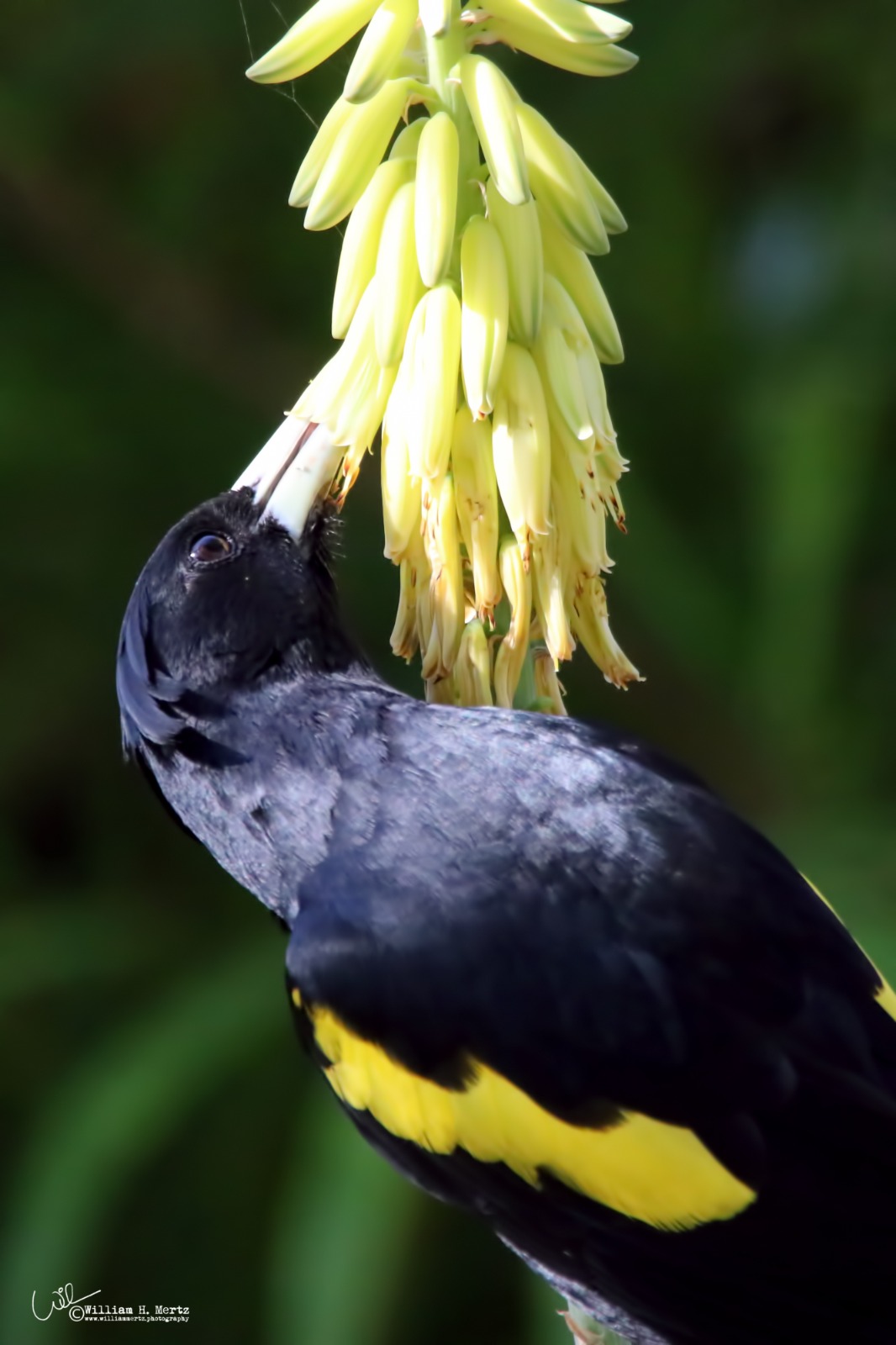
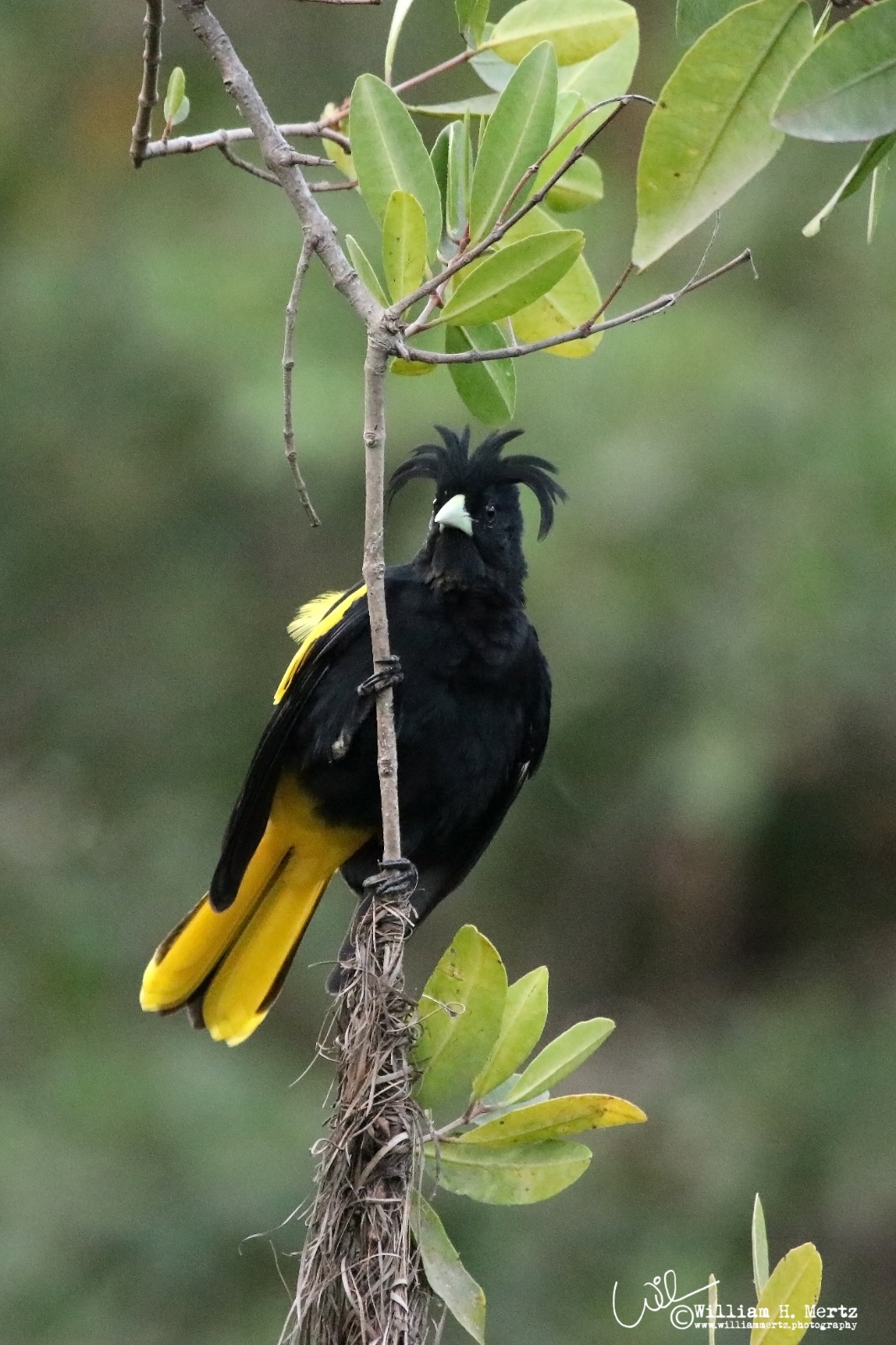
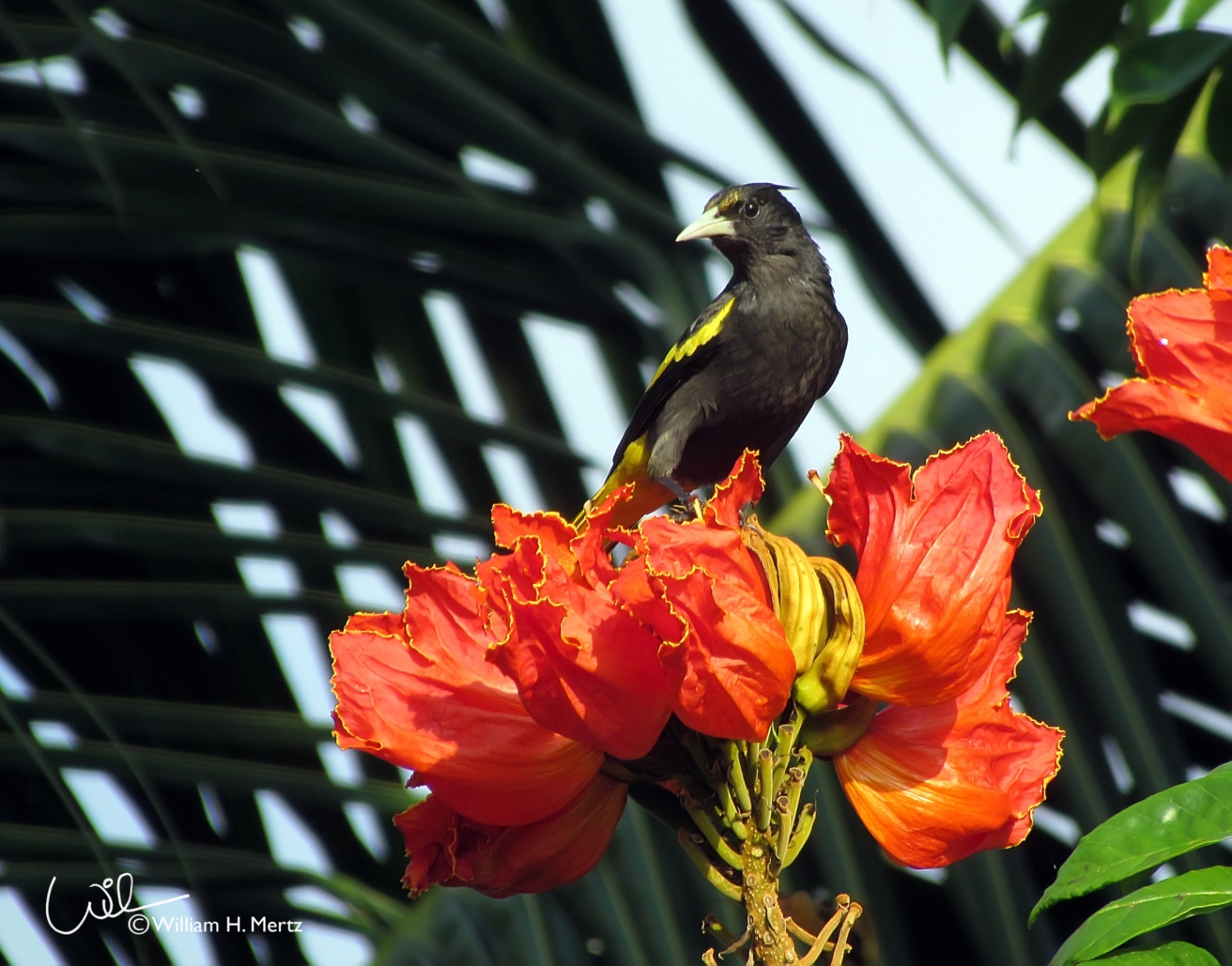
The male is about 32 centimeters of glossy black, with a broad yellow bar across the wing, a yellow rump, yellow under the tail and yellow outer tail feathers, all set off by a pale, sharp bill. The female is smaller and duller, more slate than black, with the same pattern turned down a notch. You need them side by side to really see it.
What most people never notice is the crest. Both sexes carry a loose, floppy tuft on the back of the head, and most of the time it just lies there. When a male is showing off, he raises it, and it turns out to be surprisingly large and thoroughly untidy. It looks less like a crest than a bad haircut caught in a breeze.
THE PERFORMANCE
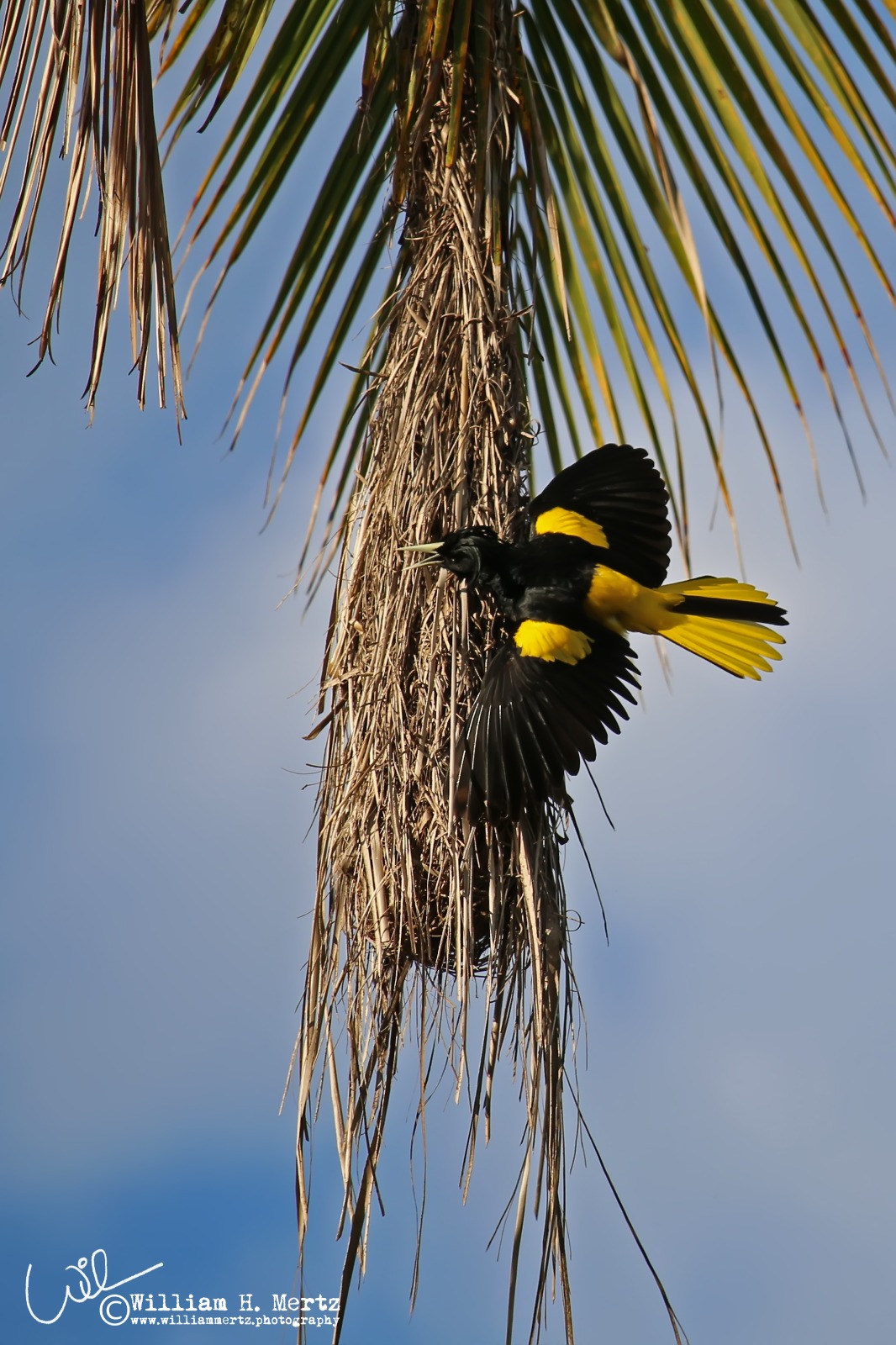
Breeding starts in early summer, and that’s when the males lose all dignity in the best possible way. A displaying male will hang upside down from a branch, or from the side of a nest, throw his wings open, fan his tail, raise that disheveled crest and call at full volume, so that every scrap of yellow he owns is on display at once. If you stand back and watch, it’s one of the better shows in town, and it’s free.
The soundtrack is not pretty. Cacique calls are not melodic in any normal sense: gurgles, clacks, wheezes, liquid pops, and the occasional clear, bell-like note that seems to come from a different bird altogether. They vary constantly in pitch and texture. If you’ve ever heard plumbing that seemed to have opinions, you’ve heard a cacique.
THE NEST EVERYONE ASKS ABOUT
The nest is a woven tube, often close to a meter long, entered from a slot near the top and ending in a rounded basket at the bottom where the eggs sit. Among caciques the weaving is done by the females, and watching one work, pushing and pulling fibers into place one by one, is worth the time if you catch it. Nesting runs from roughly June through September. Each nest is used for one season only, then abandoned to the weather.
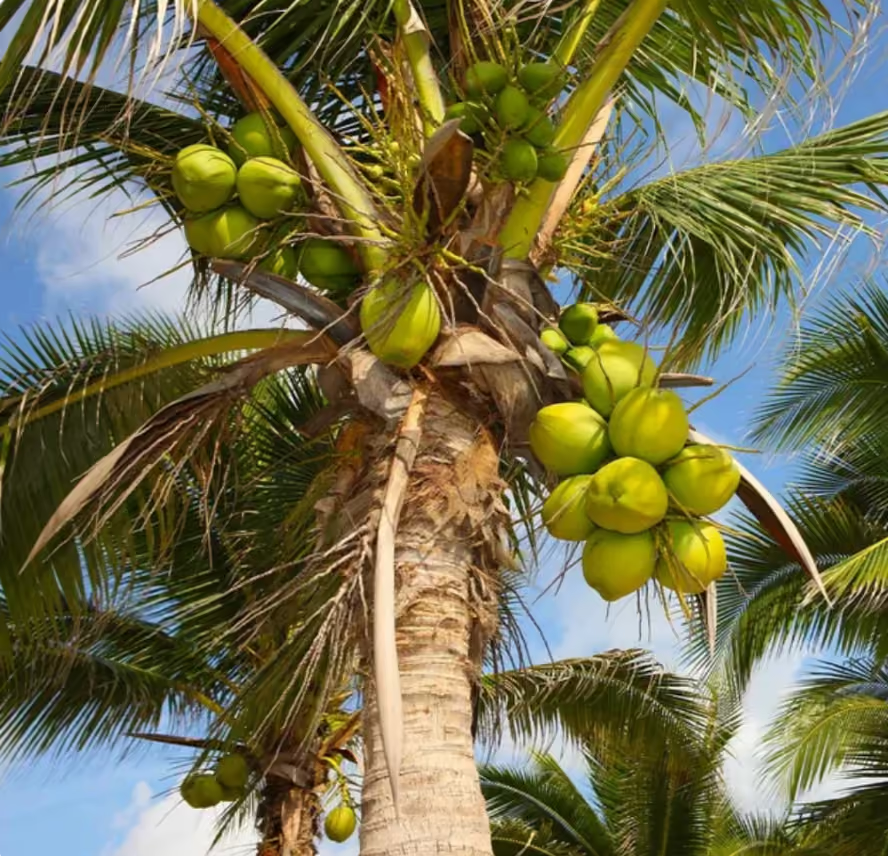
Caciques hang them where a predator has to think hard: out at the tips of branches over roads and rivers, from the big parota trees, and from the long, drooping fronds of mature coconut palms. Sometimes there’s one nest alone, sometimes a cluster.
Two types of oriole nest around Troncones, the Streak-backed and the Spot-breasted, and both weave hanging nests, too, which is where the confusion starts. The difference is length: an oriole’s nest is the shorter one, a pouch rather than a sleeve. When you see something hanging that looks closer to a wind sock than a purse, you’re looking at a cacique.
A lot of people collect the old nests after the season and hang them on porches or around the house. I’ve done it myself, more than once. If you do, take only what’s already on the ground. The birds will build new ones next year anyway, but there’s no reason to rush them.
WHAT THEY EAT, AND HOW TO INVITE THEM
Caciques are mostly fruit, nectar and pollen eaters, with insects on the side. Anything flowering gets their attention: agaves, flowering cacti, aloe vera in bloom, and the non-native African tulip trees, which they work over constantly when the orange flowers are open.
If you want them in your yard, put out papaya. A simple feeding platform with cut papaya will bring in half the birds in the neighborhood, and the caciques are close to guaranteed. They will not be polite about it.
WEATHER FORECASTING, CACIQUE STYLE
There’s a local belief that the nests predict the rainy season. If the caciques build high and especially tight at the start of the season, people expect a wet, windy year with lots of storms. Looser, longer nests are supposed to mean a mild one is ahead.
I can’t vouch for it. I’ve kept an informal rain record for years and have never thought to compare it with the nests. It’s possible the birds know something we don’t. It’s also possible they’re just building nests. I may start measuring.
WHOSE FAMILY IS THIS?
I’ll admit I had this wrong for a long time. Caciques belong to the New World blackbird family, the Icteridae—along with grackles, cowbirds, meadowlarks and the orioles. But they’re also genuinely close kin to the oropendolas, those big tropical birds farther south whose colonies hang dozens of long nests from a single tree. Genetic studies place caciques and oropendolas together on one branch of the family tree, with the Yellow-winged Cacique sitting near its base, an early offshoot of the line that led to both. So, when someone says it looks like a small oropendola, they’re more right than they know.
It's a bird that's been in front of me every day for eighteen years. Apparently, that's the best way to overlook something.